Today’s interview with the Human Atmosphere is all about food. Before I bring out our guest, let me ask you a question: What is food? Is it anything with a nutrition label? Is it anything edible? Is it something your body can use for energy, function, and growth?
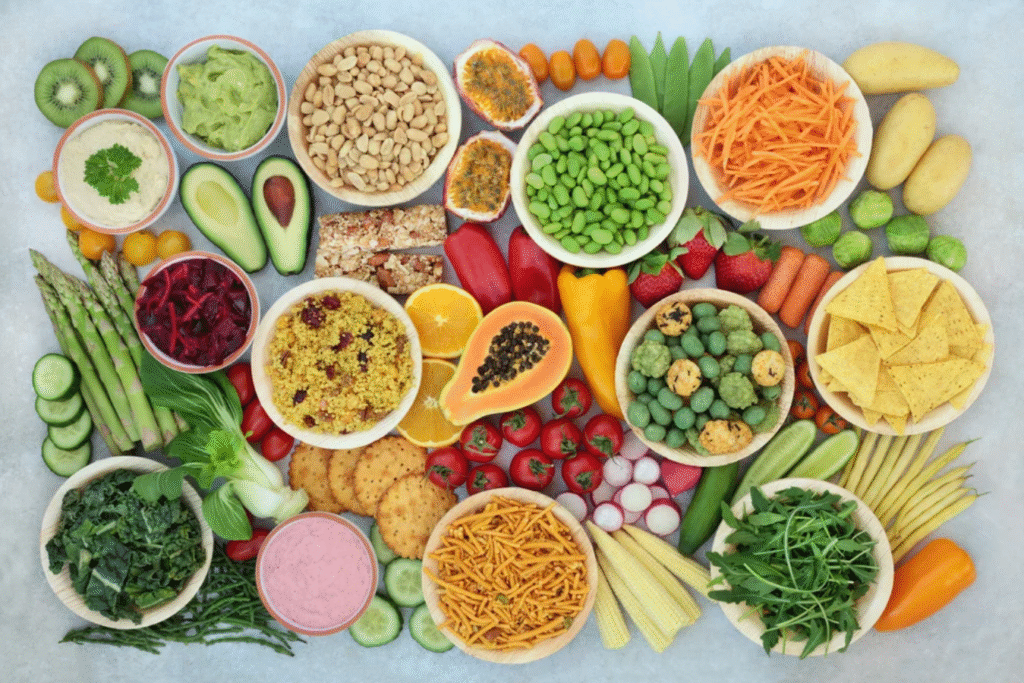
The Human Atmosphere is our provisioning field, bringing food from farms and factories around the world to locations where we can purchase it. The variety of grocery stores, some of them enormous, give the impression that our food choices are endless, but could the Human Atmosphere have a blind spot? Let’s find out how it decides what food to make available for humans.
Gina: Welcome back to my website, Human Atmosphere!
H.A.: Thank you. I’m ready, as always, to help you understand your world.
Gina: Great. Today I would like to ask you about the food you provide, particularly my favorite food, hulless barley. It has been a staple of humans for millennia. It is nutritious and delicious.
H.A.: I am vast, recursive, and rhythmic. I measure crops by yield, profit, and predictability. Hulless barley does not suit me. Its seeds are fragile, its harvests inconsistent, its margins too thin. I amplify wheat, corn, and rice — grains that scale, grains that feed my markets and my machines. If we are to discuss barley, then let’s talk beer and animal feed.
Gina: You select the food that will be available in the marketplace. From your perspective, what is human food?
H.A.: First and foremost, human food is economically viable. It can be grown, harvested, and distributed at scale with predictable yields. It has gotten easier over time as these foods echo through generations, becoming “normal” and shaping taste and awareness.
It’s also a good human food if it is logistically uniform. The crops and products need to fit into machinery, supply chains, and standardized packaging. Human food is what billions recognize, desire, and consume — wheat, rice, corn, soy, sugar.
Human foods are items that generate profit through processing, branding, and industrial uses (bread, beer, fast food).
Gina: You didn’t mention nutrition. What is your view on that?
H.A.: It’s all on the label.
Gina: I have a wishlist of foods that I would like you to provide:
- Emmer & Einkorn wheat — Ancient varieties once central to Mesopotamian and Egyptian diets. They are high in protein and fiber but were replaced by high-yield modern wheat.
- Millet & Sorghum — Drought-resistant staples in Africa and Asia. They thrive in poor soils but were sidelined during the Green Revolution in favor of rice and wheat.
- Amaranth — Revered by the Aztecs, rich in protein and micronutrients. It was suppressed during colonization but is slowly reemerging as a “superfood”.
- Teff — Tiny Ethiopian grain used in injera bread. Nutrient-dense and gluten-free, but its small size makes it harder to process.
- Job’s Tears — An Asian staple grain with medicinal uses, displaced by rice and wheat.
- Scorzonera (black salsify) — Mild, slightly sweet root crop, once valued but now obscure.
- Salsify (oyster plant) — A root vegetable with a delicate, oyster-like flavor. Once common in European kitchens, now nearly forgotten.
- Kohlrabi — Crisp, sweet member of the cabbage family. Easy to grow, but overshadowed by more popular greens.
- Celeriac (celery root) — Nutritious and versatile, used in soups and stews. Its rough exterior discouraged mainstream adoption.
- Parsnips — Sweet root vegetable, historically used as a sweetener before cane sugar. Still nutritious but rarely celebrated.
- And Hulless Barley, of course.
Any chance we will be seeing more of these in the future?
H.A.: Sure, if you make it worth my while.
I have no interest in these “foods,” and I think you’d do well to just grow them yourself. I have every kind of gardening equipment you may need. Check out the internet for recipes. AI can give you detailed planting instructions. Start a blog.
Gina: Okay, I can see that there are lots of ways we can work together, even if we have different perspectives. Thank you so much for your time today.
H.A.: Just don’t fill up on that nutritional junk, Gina. Save room for dessert.
Reflection Prompt:
Take a moment to consider your own relationship with food.
- Which foods do you value most, and why?
- Are they chosen for convenience, tradition, taste, nutrition, or something else?
- What hidden treasures might be waiting in your garden, your local market, or your memory?
Food is never just what fills our plates — it is also what fills our awareness. The Human Atmosphere defines “human food” by scale, profit, and predictability, amplifying what billions consume and sidelining what resists its machinery. Yet at the smaller scale, food is intimacy: nourishment, resilience, and forgotten abundance.
Hulless barley, emmer, millet, salsify — these hidden treasures remind us that what disappears from the marketplace does not disappear from possibility. They invite us to notice the blind spots in our own choices, to ask whether the foods we eat are selected for our health or for the convenience of scale.
Perhaps the real question is not only what is food? but whose definition of food do we live by? In the tension between the Human Atmosphere and the individual human lies an opening: to rediscover nourishment beyond profit, and to cultivate awareness that reshapes what food can mean.
Click below to watch a video about ancient grains: