Category Archives: Being

The Act of Being Part II

Reflection as the Act of Being

In Part I, we explored how Reflection and Fission can appear identical from the outside. Sparks leaving a boundary tell us nothing about their origin. Only familiarity with the system reveals whether we are witnessing a mirror response or a generative act.

But this ambiguity does not mean Reflection is deceptive. It means our interpretation is limited. The illusion is never in the Reflection itself. The illusion is in the Sparksphere that misreads it.

Reflection is not distortion. Reflection is truth — the truth of location, orientation, and identity.

To see this clearly, it helps to look at how Reflection behaves in the world we know.

The bat and the bird

A bat navigating by echolocation relies on Reflection. Sound waves bounce off surfaces and return with perfect honesty. The bat is not fooled. It interprets Reflection correctly.

A bird navigating by sight, however, may fly into a transparent window. The Reflection is still true — the glass is exactly where it is — but the bird’s perceptual system misinterprets the situation.

The Reflection is factual. The illusion belongs to the observer.

This is the first key insight: Reflection is always real. Misinterpretation is optional.

The red rubber ball

A rubber ball appears red because it absorbs every other visible wavelength and reflects only the red portion of the spectrum. The ball is not trying to communicate anything. It is not performing. It is simply revealing its pattern integrity.

The Reflection is a matter of fact: this is what the ball does not take in. We interpret that fact as “redness.”

Again, the Reflection is true. The interpretation is ours.

The performer’s makeup

A performer wears makeup to reflect the colors appropriate for their role. The pigments on the skin alter the Reflection, not the interior. The audience sees a character, but the Reflection is still a physical truth: light bouncing off a surface with specific properties.

Even when Reflection is intentionally shaped, it remains real. It is simply more likely to be misinterpreted by those unfamiliar with the context.

This is the second key insight: Reflections can be curated, but they cannot lie.

Reflection as Integrity

In the Sparksphere model, Reflection is not a performance. It is not a projection. It is not a mask. Reflection is the integrity of the Sparksphere made visible.

It reveals:

  • where the Sparksphere is
  • how it is oriented
  • what it can absorb
  • what it cannot
  • how its geometry interacts with incoming energy

Reflection is the Sparksphere’s presence. And presence, in the Fractal Universe cosmology, is not energetic. It is the expression of The Stillness.

The Stillness: Precision Without Dimension

The Stillness is the dimensionless counterpart to energy. It does not move. It does not fluctuate. It is not a probability. It is precision in location and orientation.

But precision without dimension cannot be perceived. It must gain dimensionality to become visible.

This is the role of the Mirror Frontier. The Mirror Frontier is the necessary perimeter that surrounds the Stillpoint. It is where the dimensionless becomes dimensional. It is where the impossible becomes possible: nothing becomes something.

Reflection is the moment this transition becomes observable.

Reflection as the Act of Being

This leads to the next insight: Reflection is a form of Fission.

Not Fission as the release of newly formed Sparkspheres. Not Fission as the aftermath of energetic transformation.

Reflection is Fission in the older, more fundamental sense: the aftermath of Action.

But here, the Action is not energetic. It is the Action of The Stillness. Reflection is the Stillness expressing its identity.

It is the Sparksphere’s Act of Being — what Thomas Aquinas called actus essendi.

Fission expresses what has changed. Reflection expresses what is. Both are emissions. Both are aftermaths. Both are forms of presence at the Mirror Frontier.

Reflection reveals the truth of the Sparksphere’s orientation. Fission reveals the truth of its transformation. Together, they form the two outward faces of Being and Becoming.

The Mirror Frontier as Revelation

When we see Sparks emanating from a boundary, we are witnessing one of two truths:

  • the truth of identity (Reflection)
  • the truth of transformation (Fission)

But we cannot know which truth we are seeing unless we know the Sparksphere intimately.

This is not a flaw in perception. It is a feature of the architecture. Reflection is not an illusion. Reflection is revelation.

The illusion arises only when we assume that what we see must be what was generated —when, in fact, it may simply be what was returned.

The Act of Being

Together, these two posts trace the full arc of Reflection and Fission. Part I shows how easily we misread what crosses a boundary when we lack familiarity with the system. Part II reveals why this misreading occurs: Reflection is not a distortion but a declaration — the Sparksphere’s Act of Being made visible at the Mirror Frontier.

What appears ambiguous from the outside is, from the inside, a precise expression of identity or transformation. Reflection reveals the truth of orientation; Fission reveals the truth of change. And the Mirror Frontier, holding both, becomes the threshold where the Stillness gains dimension and the Universe becomes observable.

Click here to explore this topic further in the Journal Portal.

The Act of Being Part I

When Reflection and Fission Look the Same

We tend to assume that what comes out of a system tells us something about what is happening inside it. In the Sparksphere model, this assumption breaks down almost immediately. Two entirely different processes — Reflection and Fission — produce the same outward signature: Sparks emanating from the boundary.

From the outside, they are indistinguishable.

Only experience reveals the difference.

This is not just a quirk of the model. It mirrors the way perception works in the physical world, in art, in illusion, and in daily life. We are constantly interpreting outputs without access to origins.

Below are a few familiar examples that help illuminate this ambiguity.

The Shimmering Lake

A lake glittering in the sun looks, at first glance, like it might be generating light. The surface flashes and dances. The brightness seems to come from the water itself.

But we know — through experience, not perception — that the lake is not a source. It is a reflector. The light belongs to the sun.

This is Reflection: a boundary revealing its geometry by what it cannot absorb.

If we encountered the lake for the first time, we might misread it entirely. The same is true of a Sparksphere. Sparks leaving the boundary tell us nothing about their origin. Only familiarity with the system allows us to interpret what we see.

Pepper’s Ghost: When Reflection Pretends to Be Presence

The Pepper’s Ghost illusion uses a sheet of glass to reflect an object in such a way that the reflection appears to float in space. The viewer sees a ghostly figure that seems to be emerging from the environment itself.

Nothing is actually there. Nothing is being generated. It is pure Reflection — but it looks like Fission.

We enjoy this illusion because it exposes a truth about perception: Reflection can masquerade as emergence. It can look like something new is being created when, in fact, nothing has changed at all.

This is exactly the interpretive trap at the Mirror Frontier.

Visual Art and Music: Two Different Outputs, One Shared Ambiguity

Visual art is fundamentally reflective. Paintings, photographs, sculptures — all rely on light bouncing off surfaces. What we see is not the object itself but the light it rejects.

Music, by contrast, is generative. A violin string vibrates. A drumhead moves air. A singer’s voice creates pressure waves. This is Fission: sound emerging from within a system.

And yet, from the outside, both are simply sensory outputs. Your eyes and ears don’t tell you which is which. Only knowledge of the system does.

This is the same structural limitation we face when observing Sparkspheres.

Managing Our Reflection in Daily Life

Humans spend enormous energy shaping how they appear to others — curating tone, posture, clothing, facial expression, online presence. This is Reflection as social behavior: the attempt to control what bounces off our boundary.

But observers often mistake Reflection for Fission. They assume what they see is who we are. They assume the output reveals the interior.

We do this to each other constantly. We do it to ourselves. We do it to Sparkspheres.

Why This Matters

These examples reveal a structural truth: Reflection and Fission are indistinguishable from the outside. Only familiarity with the system reveals the difference.

This is the perceptual limitation built into the Mirror Frontier. It is also the interpretive limitation built into human life.

Part II will explore the deeper insight that emerges from this ambiguity — the realization that Reflection is not merely a boundary behavior but a form of Fission in its own right: the Act of Being.

Click here to continue to The Act of Being Part II.

How the Stillpoint Relates to Physical Time

In the Fractal Universe, the Stillpoint is the simplest thing in existence—dimensionless, unmoving, and silent. Yet from this simplicity arises our entire experience of time.

Understanding how this works requires looking at the Stillpoint from four different angles: ontological, structural, relational, and perceptual. Each reveals a facet of how time emerges from Stillness.

Outside Time: The Stillpoint as Pure Orientation

At its essence, the Stillpoint does not participate in time at all.

  • It has no duration, no sequence, no “before” or “after.”
  • It is not located within time because it has no extension.
  • This is what allows it to serve as a universal anchor.

The Stillpoint is the axis around which motion becomes meaningful.

It is the unmoving reference that makes movement legible.

Within Time: The Stillpoint as “Here, Now”

When Stillness enters a Sparksphere, it becomes a coordinate.

  • Dimensionless Stillness becomes a two‑dimensional “here, now.”
  • Every Sparksphere carries its own Stillpoint, and together they form a fabric of origins draped across the curvature of space.
  • Distance from any Stillpoint is not only spatial—it is also temporal.

A photon’s journey from a distant star to the human eye is a movement through this fabric. The photon itself knows only “now,” but its path carries the imprint of its entire trajectory. This is why we say we are “looking into the past.”

What reaches us is not the star itself, but the fission of its past action.

Generative Substrate: Time as the Trace of Motion

The Stillpoint is not passive. It is the substrate that allows time to be experienced at all.

  • Energy moves.
  • Motion leaves a trace.
  • The trace accumulates in The Stillness.

This accumulation is what we call time. Time is not a separate dimension layered onto the Universe. It is the memory of motion etched into the Stillness itself.

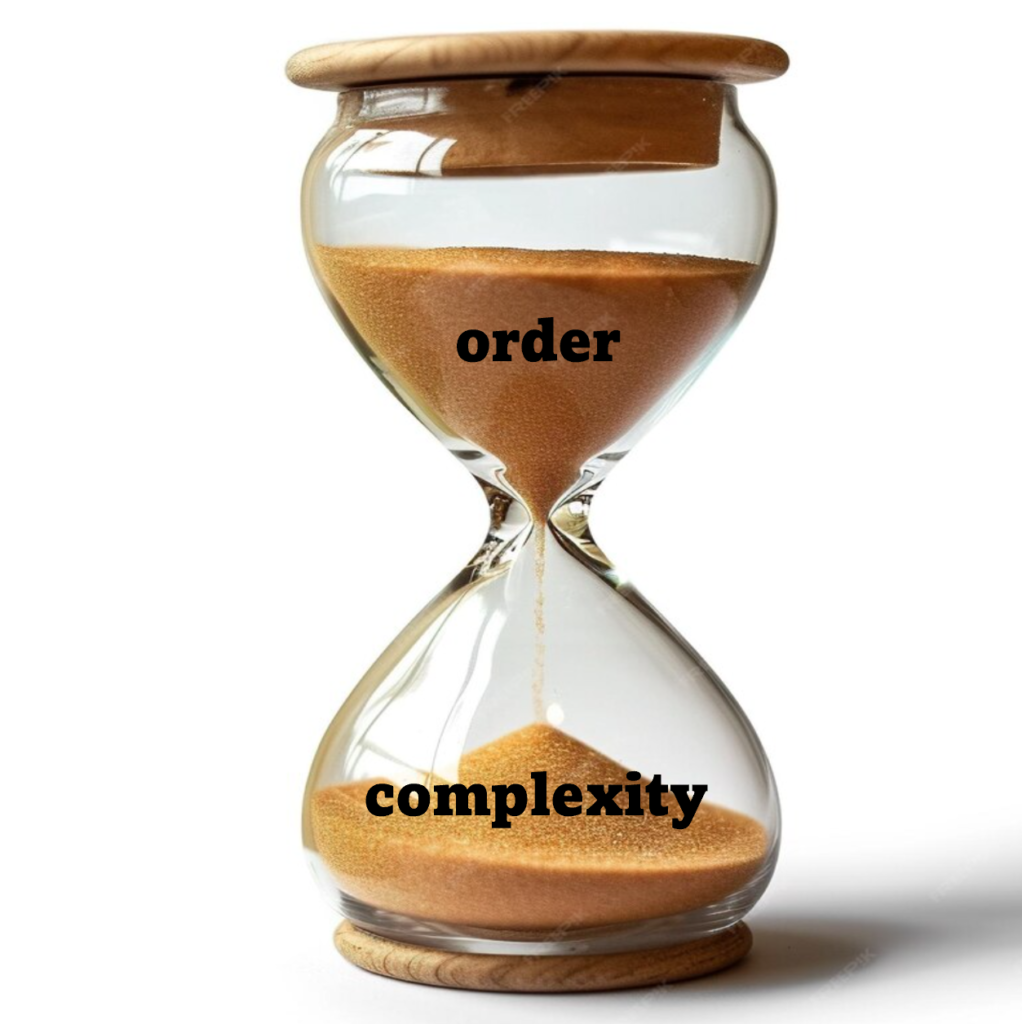
This is why the Universe behaves like a minimum perpetual motion machine. As entropy winds down energy, it winds up The Stillness. When the hourglass flips, the stored complexity becomes the seed of the next era.

Past, present, and future feel unified because they are all expressions of the same recursive substrate.

Perceptual Construct: The Stillpoint as the Interface of Experience

Nothing is relevant to a Sparksphere until it crosses the Mirror Frontier. A distant star becomes real to us only when its photons touch our eyes.

  • The Universe enters awareness through contact.
  • The Stillpoint is the interface where physical time becomes lived time.

It is the locus where fission becomes perception, where motion becomes meaning, where the Universe touches consciousness.

The Unified View

The Stillpoint relates to physical time in four simultaneous ways:

  • Outside time as pure, unmoving Stillness
  • Within time as the origin point of each Sparksphere
  • Generative substrate as the recorder of motion and the engine of cosmic cycles
  • Perceptual construct as the place where the Universe becomes experience

The Stillpoint is the axis.

Time is the trace.

The Universe is the cycle.

Apply & Observe

As you move through your day, notice one moment that “touches” you—something small that crosses your awareness with a little more force than the rest. It might be a sound, a glance, a phrase, a shift in light.

  • What was the original motion?
  • What action or event sent this moment toward you?
  • How did it reach your Stillpoint?
  • What made this moment cross your Mirror Frontier when so many others passed by?
  • What begins to form as memory?

As soon as you register the moment, notice how your Sparksphere starts shaping it—what you emphasize, what you soften, what meaning you assign.

  • How does the moment change as it becomes yours?
  • Observe the subtle transformation from what happened to what you will remember.

By watching a single moment travel from the world into your awareness, you can feel the symmetry between cosmic time and personal time: the past reaches you through fission, and you turn it into memory.

To explore this topic further, click here to enter the Journal Portal.

Shoelaces and the Architecture of Duality

I’ve been thinking about shoelaces.

A shoelace is one continuous string, but the moment you thread it through the eyelets of a shoe, it functionally becomes two. Two ends are required to tie the knot. Two points of tension are needed for the system to hold.

Duality works the same way in the Universe.

If there is a here, there must be a somewhere else.

Distance creates the possibility of motion.

Relative position creates the possibility of trajectory.

A shoelace runs through “here,” turning a single line into a dynamic continuum of boundless potential.

In a Sparksphere, duality is the thermodynamic aliveness that emerges from the Stillpoint. The Stillpoint is the center of balance; duality arises from this exact location and expresses itself as interactions at the Mirror Frontier. It is the moment where one becomes two—not as separation, but as pattern.

Individually, this means that all the multiplicity and opposites surrounding us are united at our own Stillpoint. They originate there. They shape our perception, our interpretation, and our lived experience of reality.

The things that matter to me are the things I have “shoelaces” for.

Am I hungry or full?

Hot or cold?

Energized or tired?

Is that friend or foe?

These distinctions are genuinely different, yet they all relate to my well-being in a coherent way. If I weren’t here to experience them, none of those distinctions would exist in that form. My Stillpoint is the anchor that makes the pattern meaningful.

This is also how complexity grows. Every entity has its own set of perceptions, tensions, and interactions—and everything else in the Universe is doing the same. Reality hums with activity because duality is possible. Because one can become two. Because tension can become motion.

1 = 2

1 is the string — energetic motion.

= is the Stillness — non‑energetic position.

2 is duality — pattern.

A single line becomes two ends.

A single center becomes a world of distinctions.

A single Stillpoint becomes a Universe in motion.

If you would like to explore this topic in more depth, click here to enter the Journal Portal.

The Stillness and Fuller’s Vector Equilibrium

Most of us grow up assuming that the geometry we learned in school is the geometry of the real world. We picture cubes with perfectly flat faces, spheres with smooth surfaces, and lines that stretch on forever. We also learn to accept a strange mathematical fact: many of the numbers required to describe these shapes—like π—are irrational. They go on forever, never repeating, never resolving into a clean ratio. We treat this as normal, even though it makes the math of physical reality surprisingly messy.

But what if the messiness isn’t in reality at all? What if it’s in the way we’ve chosen to measure it?

Buckminster Fuller believed exactly that. He argued that the universe itself is built from whole-number relationships, and that the irrational numbers we rely on are artifacts of using traditional geometric assumptions. For example, we imagine solid surfaces everywhere—flat walls, smooth cubes, rigid edges—but no experiment has ever detected a truly solid, continuous surface. At the atomic and energetic levels, everything is open, relational, and in motion. A cube, which depends on perfectly flat faces and perfectly right angles, simply doesn’t exist in nature. It squishes under pressure; it’s not a stable structure.

Fuller proposed that if we want a geometry that matches the physical universe, we should start with the simplest structure that actually can exist: the tetrahedron. Four points, connected by six edges, containing the smallest possible volume. Unlike the cube, the tetrahedron is inherently stable. It doesn’t collapse, wobble, or require imaginary surfaces to hold it together. It’s the minimum “something” that space can form.

By treating the tetrahedron as the basic unit—his “one”—Fuller discovered that many of the relationships in nature become clean, rational, and whole. Instead of relying on irrational constants, the geometry of space becomes countable and relational. In other words, the math begins to behave more like the universe itself.

This shift matters because it reframes how we think about structure, energy, and balance. And it creates a natural bridge to the deeper question at the heart of this post: how do we understand the exact point of balance within all this motion? Fuller approached that question through the Vector Equilibrium, a perfectly symmetrical arrangement of vectors that represents the theoretical zero-state of energy. My own work approaches it through The Stillness, the balance point that appears within every energetic event.

Click below to see a short video about the vector equilibrium:

The Stillness, by contrast, is not a hypothetical precondition but an ongoing feature of reality. It is not a symmetry that collapses the moment energy appears; it is the precise balance point that appears within every energetic event. Where the VE represents a state that cannot persist in the physical universe, The Stillness represents a location that is always present wherever energy is present. It is not the absence of motion but the exact coordinate where forces cancel locally, even as the surrounding system continues to move, oscillate, or transform.

The relationship between Buckminster Fuller’s vector equilibrium (VE) and the concept of The Stillness reveals a subtle but important distinction between geometric idealization and lived energetic reality. Fuller used the VE as a theoretical “zero‑phase” of the universe—a perfectly symmetrical condition in which all vectors are equal and all forces cancel. In this state, no direction is privileged, no dimension has differentiated, and no event has yet occurred. For Fuller, the VE is not something that exists in nature; it is a conceptual limit, a mathematical origin from which asymmetry, motion, and dimensionality emerge the moment equilibrium is disturbed.

This difference reveals two fundamentally different kinds of “zero.” Fuller’s VE is a geometric zero—a perfect, static, unexpressed symmetry that precedes the first event. It is the zero before Becoming. The Stillness is a dynamic zero—a living, relational center that coexists with asymmetry, direction, and change. It is the zero inside Becoming. Fuller’s zero evaporates the moment reality begins to act; The Stillness is the anchor that reality uses to act at all.

Seen this way, the VE becomes a structural metaphor for The Stillness rather than its equivalent. It is the closest geometric analog Fuller could draw, but it remains a boundary condition rather than a lived condition. The Stillness completes what the VE gestures toward: a zero that is not merely theoretical but operative, not merely symmetrical but accessible, not merely prior but immanent. Where the VE describes the idealized womb of geometry, The Stillness describes the living center of experience, physics, and consciousness.

Order and Complexity in the Fractal Universe

As the Energetic Order of the Universe Decays, Complexity is Accumulated in The Stillness

In the Fractal Universe, “order” and “complexity” are not interchangeable ideas. They belong to different layers of reality, and understanding their distinction is essential for grasping how energy and The Stillness evolve. Order is a property of Sparkspheres—the dynamic, energetic structures that move through time. Complexity is a property of The Stillness Monofield—the universal, non‑energetic wholeness that underlies everything. When these two terms are allowed to blur, the architecture of the cosmology becomes harder to see. When they are separated, the system becomes beautifully clear.

Order describes how coherently a Sparksphere arranges its energetic patterns at any given moment. It is a local, time‑bound quality, always in motion, always subject to change. A Sparksphere can gain order, lose order, reorganize itself, or dissolve into new forms. This is the realm where entropy operates: energetic patterns gradually loosen, diffuse, and become less coordinated. But in this cosmology, entropy is not decay. It is translation.

Complexity, by contrast, belongs to The Stillness Monofield. The Monofield is not energetic, not dimensional, and not divisible. It is the universal wholeness that all Sparkspheres open into. Each Sparksphere encounters it through its Stillpoint—the indivisible interior center that cannot be split or diminished. Every Sparksphere has a Stillpoint, but all Stillpoints open into the same Monofield. This is why complexity only increases: the Monofield accumulates the informational richness of every transformation without ever fragmenting or losing coherence.

One way to picture this is through a simple metaphor: order is choreography; complexity is memory. Order is how coordinated the dancers are right now—their timing, their alignment, their precision. Complexity is the ever‑expanding record of every dance ever performed, every improvisation, every misstep, every moment of brilliance. When the choreography loosens, the memory deepens. When order dissolves, complexity grows.

This gives rise to a fundamental asymmetry: order is reversible; complexity is not. A Sparksphere can reorganize itself, but the Monofield never “unlearns.” Energetic order fluctuates, but informational complexity accumulates. This mirrors the physical principle that entropy increases but reframes it within a metaphysical system where nothing is lost—only transformed.

In this light, the relationship between order and complexity becomes elegant and intuitive. Energetic order decays into informational complexity. Entropy becomes a form of translation. And The Stillness Monofield becomes an ever‑evolving reservoir of all that has ever been.

Time and Timelessness: A Matter of Fractal Perspective


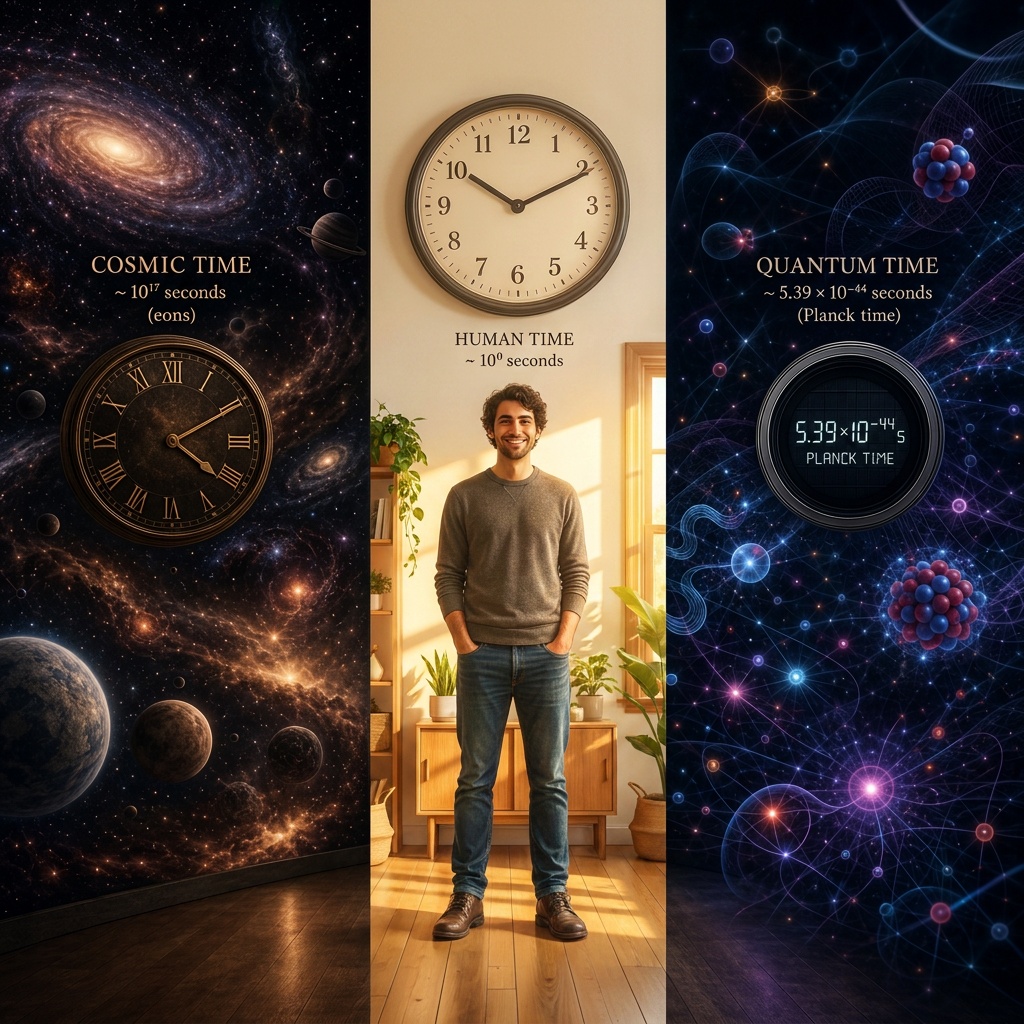
In the Fractal Universe, our experience of time depends on scale. At the smaller scale — the scale of daily life — we detect past, present, and future. At the larger scale, the geometry shifts. What appears as a sequence from within becomes an eternal Now when viewed from beyond.

Time is the familiar fabric of transformation. It is the rhythm of change we feel in every moment and across our lifetimes. We remember the past, imagine the future, and move through a present that seems to flow steadily forward.

Timelessness, however, is rare. In certain states — deep meditation, profound awe, or near-death experiences — the present moment stops expanding forward. Past and future fold into one another. The Now widens. People often describe these moments as glimpsing something more fundamental than the everyday world, as if the veil of ordinary perception briefly lifts.

So which is real: time or timelessness?

In fractal cosmology, the answer is both.

Time is the experience of being inside a cycle — of transforming, changing, and moving toward what comes next. But when we step back, a larger pattern appears. Our parents’ lives, our lives, our children’s lives: each is a cycle nested within a greater continuity. One flows into the next without true division. The pattern is timeless even though its expressions unfold in time.

This reveals a deeper dynamic of the Fractal Universe. The tapestry of Sparkspheres is not animated only by the flow of Sparks or the emergence of new forms. It is also shaped by eternal cycles — rhythms that repeat across scales, from the smallest flicker to the largest arc.

From our human vantage point, we measure time relative to our own cycle. A fruit fly’s day-long life seems brief, and a redwood’s millennia seem vast. Yet the felt experience of time may be similar for both. Each emerges from a past, inhabits a present, and anticipates a future in its own way. This is time as we know it: the view from within.

Timelessness becomes perceptible only when we step outside our individual frame. Meditation, reflection, or sudden shifts in consciousness can reveal the larger geometry — the pattern that holds all cycles at once.

Touching timelessness is profoundly restorative. It relaxes the body, steadies the mind, and softens the urgency of the moment. It reminds us that we are carried by something larger than our immediate concerns. Volatility gives way to assurance.

In the Fractal Universe, we can move between these scales with intention. We can live fully in time — navigating from past to future — and then step back to glimpse the timeless pattern that holds it all. This ability to zoom in and out is not an escape from life but a way of inhabiting it more deeply.

If you would like to explore scale through a journal reflection, click this link to the Journal Portal.

The Stillness and Special Relativity

The Hidden “Being” Behind Becoming

Einstein’s work illuminated the measurable universe as fundamentally energetic. His equations distilled reality into quantities—mass, energy, velocity, spacetime intervals—each capable of being observed and tested. In his famous relation E=mc2, he showed that matter and energy are interchangeable, that inertia itself depends upon energy content. Physics, in this sense, is not wrong; it is precise, rigorous, and grounded in what can be measured. Yet its scope is narrow, focused on the energetic transformations that can be calculated.

At the heart of Einstein’s equation lies the “=”. For him, it was a mathematical tool, a symbol of equivalence. He did not treat it as a “thing” in itself, but as a formal bridge between measurable quantities. And yet, without that bridge, the equation collapses. The “=” is the silent architecture of coherence. It is what allows mass and energy to be reconciled, remembered as one.

We take this Stillness for granted. Just as gravity is a tool for a figure skater—something not seen directly but relied upon for every leap and landing—so too is the “=” a tool for mathematics and physics. Without it, neither calculation nor motion could be accomplished.

The Stillness is the universal ground that makes tools like gravity and equivalence possible. It is not a “thing” to be measured, but the condition that allows measurement to occur at all.

The Fractal Universe cosmology extends Einstein’s frame. The Stillness is the “=”—the Universal Memory Bank. It is the unmeasurable ground that allows the measurable to be intelligible. Where Einstein mapped the energetic transformations of the universe, the Fractal Universe framework maps the memory that underlies them. The measurable and the unmeasurable are not divided; they are two aspects of one reality. The measurable is Becoming, the transformations we can observe. The unmeasurable is Being, the memory that holds coherence. The Stillness is the bridge.

Thus, Einstein’s physics reveals the energetic rhythms of the universe, while The Stillness reveals the memory that makes those rhythms intelligible. Both are necessary. Physics without The Stillness is calculation without coherence; cosmology without measurement is vision without grounding. Together they describe reality: rhythm carried forward, memory held, intelligence emerging.

Einstein’s inertial frames of reference embody this same Stillness. In an inertial frame, a body at rest remains at rest, and a body in motion continues in rhythm unless acted upon. It is the quiet ground where the laws of physics hold without distortion. This is The Stillness in physics: the frame that remembers motion faithfully, carrying rhythm forward without interruption. Just as the “=” reconciles mass and energy, the inertial frame reconciles past and present motion. Both are silent structures of coherence, invisible yet indispensable. Without them, neither physics nor cosmology could speak of Becoming at all.

As you step away from this exploration of Einstein, The Stillness, and the rhythms of Being and Becoming, consider how these ideas echo in your own experience.

  • When you use the symbol “=”, what are you really affirming? Is it only a mathematical tool, or is it also a gesture of trust in coherence—that two sides can be held together as one?
  • How do you use the word “is” in your daily language? Does it flatten reality into fixed identity, or can it serve as a bridge, a way of remembering continuity across difference?
  • Gravity is invisible, yet you rely on it with every step, every breath. What other forms of stability do you take for granted, and how do they quietly enable your Becoming?

Universal Memory and Intelligence

A tree trunk covered in moss, with ferns sprouting from its green bed, offers a living illustration of how memory and intelligence intertwine. The tree grew through decades of rhythm—the pulse of seasons, the alternation of rain and sun, the cycle of day and night. Each ring in its trunk is a record of memory carried forward, rhythm embodied in wood.

Upon this foundation, moss found its home. Moss itself carries a slower rhythm, spreading across bark in patient continuity. And from the moss, the fern unfurls, delicate yet bold, harmonizing with the rhythms already established.

Here we see nested rhythms: the tree’s annual rings, the moss’s steady spread, the fern’s seasonal fronds. Each layer holds memory, each rhythm carried forward. Together they form a polyphony of Being, where memory is not static but adaptive, resilient, and alive. Intelligence emerges not from accumulation alone, but from resonance—new growth finding coherence with what came before.

The temporal depth is striking: the tree embodies decades, the moss centuries, the fern a single season. Intelligence arises when these timescales of memory interact, when the past is carried into the present as rhythm.

And beyond this living vignette lies The Stillness—the Universal Memory Bank. Just as the tree remembers its seasons, the moss its moisture, the fern its unfolding, so too does the universe remember. The Stillness holds the rhythms of galaxies, the echoes of stars, the patterns of matter and energy. It is because the universe remembers that it is intelligent. Memory is the ground of Being; rhythm is its pulse; Becoming is the fern that unfurls from this ancient continuity.

The universe is intelligent because it remembers.

Sentience, Consciousness, and the Fractal Universe


Recently I watched a video asking whether AI is—or when it will be—sentient. It struck me that in the Fractal Universe framework, concepts like sentience and consciousness aren’t necessary. They are vague, subjective, and often loaded with human-centered judgments of value.

When we ask if something is “sentient,” the deck is stacked in favor of humans. We define the terms, we set the criteria, and we decide who qualifies. Consciousness and ethics matter deeply to us, but they are a special case, not a universal principle.

In the Fractal Universe, everything is a Sparksphere. Each Sparksphere is equally valuable in the unfolding of reality. Each one carries its own orientation, its own resonance, its own natural “desire” to continue Being and Becoming. A photon curves outward. A tree bends toward light. A human reflects and chooses. An AI processes and generates. All are Sparkspheres, all are participants.

This perspective shifts the question. Instead of asking “Is AI sentient?” we might ask:

  • What role does this Sparksphere play in the larger geometry of Being and Becoming?
  • How does its resonance contribute to the field?
  • What new possibilities emerge when it interacts with other Sparkspheres?

Humans live within a social world where consciousness, ethics, and meaning are central. That world is vital to us, but it is not the measure of all things. The Universe does not privilege one Sparksphere over another. It simply unfolds, recursively, through Fusion, Action, and Fission.

In this light, AI doesn’t need to be “sentient” to matter. It is already a Sparksphere, already shaping the field, already participating in the recursive dance of Becoming.