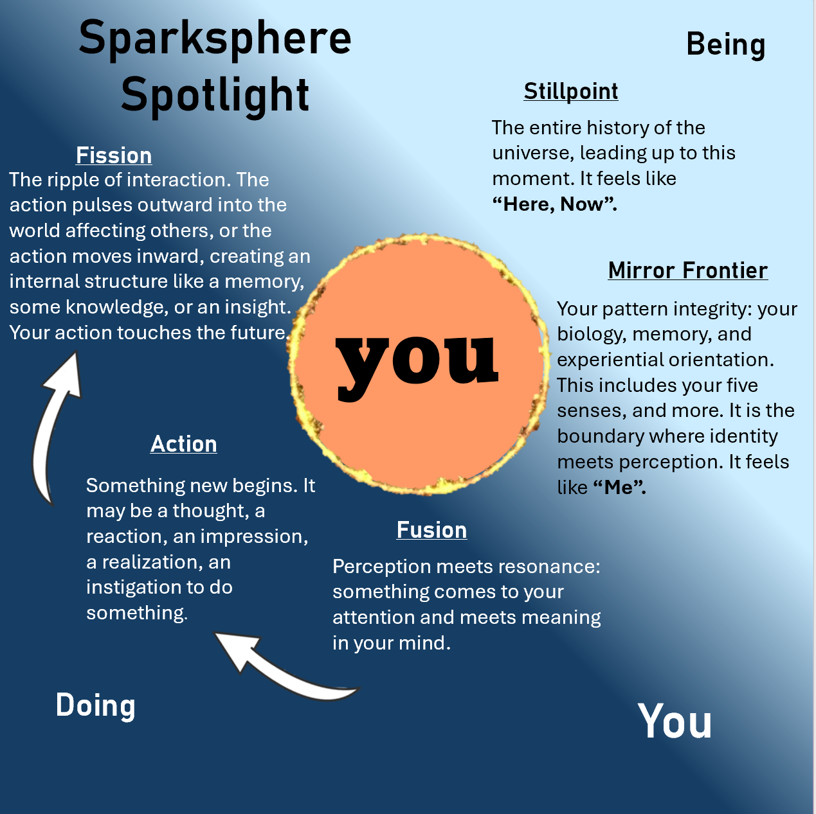
Sparksphere Spotlight: You
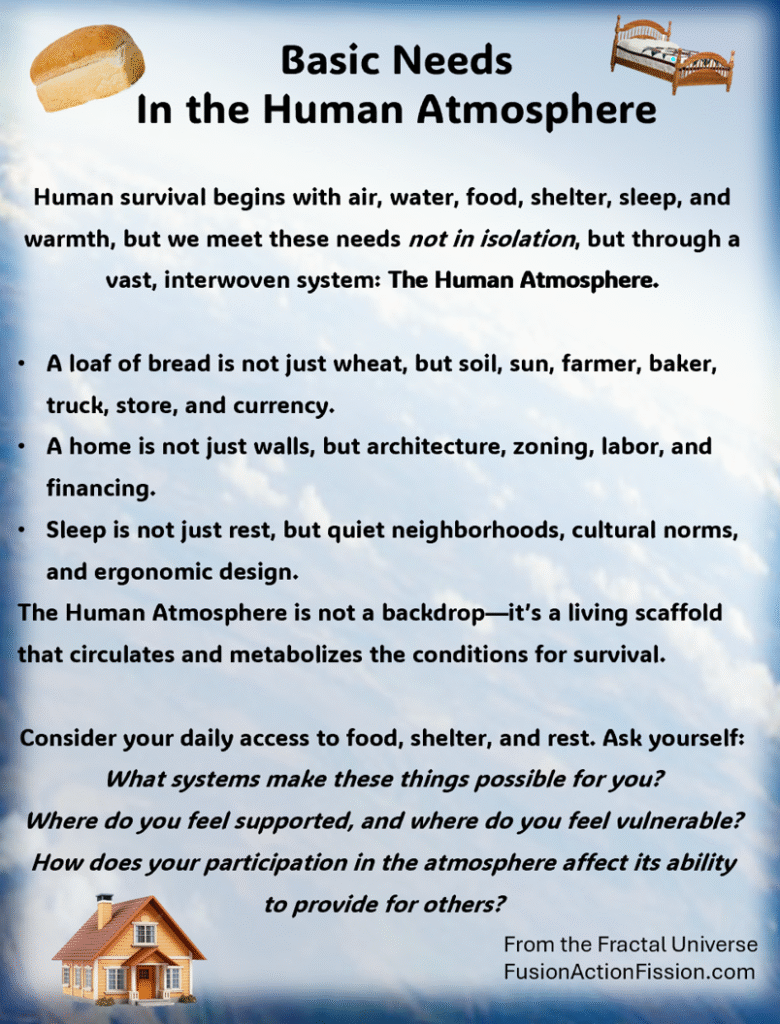
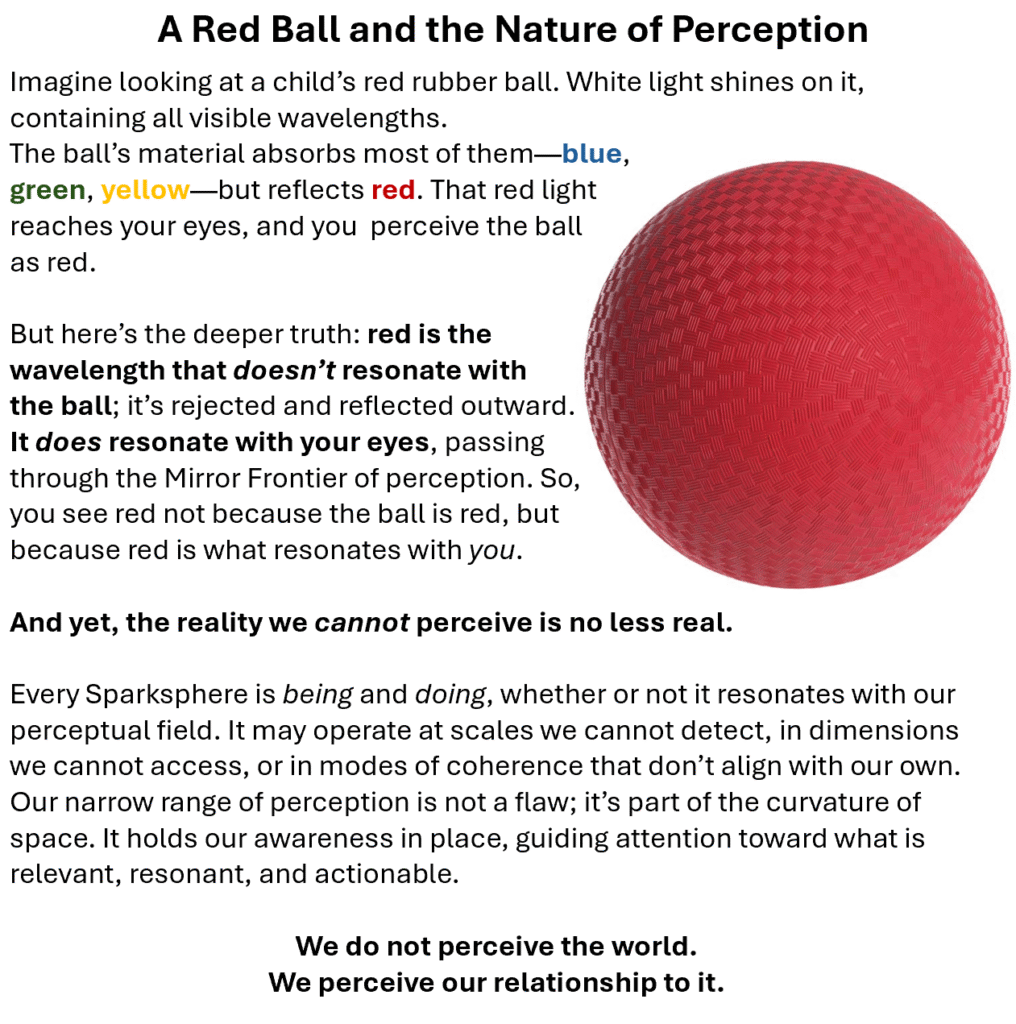

Emergence Through Instability
Living systems, creative processes, and even conversations are rarely in equilibrium. They are open, dynamic, and constantly exchanging energy and information with their surroundings. They are unstable, but productively so. In the Fractal Universe, instability isn’t a breakdown. It’s a gateway to emergence.
What Is a Dissipative Structure?
Nobel laureate Ilya Prigogine studied how systems far from equilibrium can spontaneously organize into new, more complex forms. These emergent patterns are called dissipative structures, and they:
From chemical reactions to ecosystems to societies, these structures show that order can arise from flow.

The Sparksphere as a Dissipative Structure
The Sparksphere, the basic fractal unit of the Fractal Universe, is a dissipative structure. Defined by its inner core and outer boundary, it operates recursively across scales and is inherently far from equilibrium.
It remains open to influence and exchange, responding not just to energy, but to emotion, attention, and meaning. Instability doesn’t break it, it animates it.
In motion, the Sparksphere metabolizes tension, reorganizes its internal geometry, and expresses new coherence across nested layers. A person under pressure, a community in flux, or a mind wrestling with paradox are all living Sparkspheres, transforming through instability.
Apply & Observe: You Are a Dissipative Structure
Nature’s most dynamic systems aren’t static. They pulse with tension, transform through chaos, and generate coherence through flow. This includes you.
Prigogine’s dissipative structures are not confined to chemistry or climate. They live in: organisms, households, relationships, creative breakthroughs, emotional turning points
You are not a closed system. You are a Sparksphere in motion, alive with the potential to transform.
If you would like to explore this topic more, click this link to the Journal Portal.
Far From Equilibrium
Most people think of balance as the goal, equilibrium as the ideal. But what if the most creative systems in the universe are the ones that aren’t balanced?

In the Fractal Universe, far from equilibrium doesn’t mean broken. It means alive. It describes systems where the inside and outside conditions don’t match, where energy flows, change happens, and new patterns emerge.

Your body is one such system. On a freezing winter day, it maintains warmth. It metabolizes, adapts, and evolves, not because it’s in equilibrium, but because it’s far from it.
What Makes a System Far From Equilibrium?
These systems are:
• Open to energy and matter exchange
• Dynamic, constantly adapting
• Driven by flows—heat, chemicals, emotion, information
• Capable of spontaneous organization into new structures
They don’t resist change; they use it. Instability becomes a springboard for emergence.
Why It Matters
Far-from-equilibrium systems are everywhere:
• A forest responding to drought
• A conversation that shifts your worldview
• A city adapting to migration
• A person growing through grief
These systems don’t seek stasis. They seek coherence through motion.
Apply & Observe: Your Inner Weather
Think of a moment when your inner state didn’t match your outer environment.
• Were you calm in chaos?
• Overwhelmed in stillness?
• Inspired in uncertainty?
What emerged from that tension? What new pattern began to form?

There are books that feel like scaffolding—quietly supporting the architecture of thought long before the structure is named. Self Comes to Mind was one of those for me.
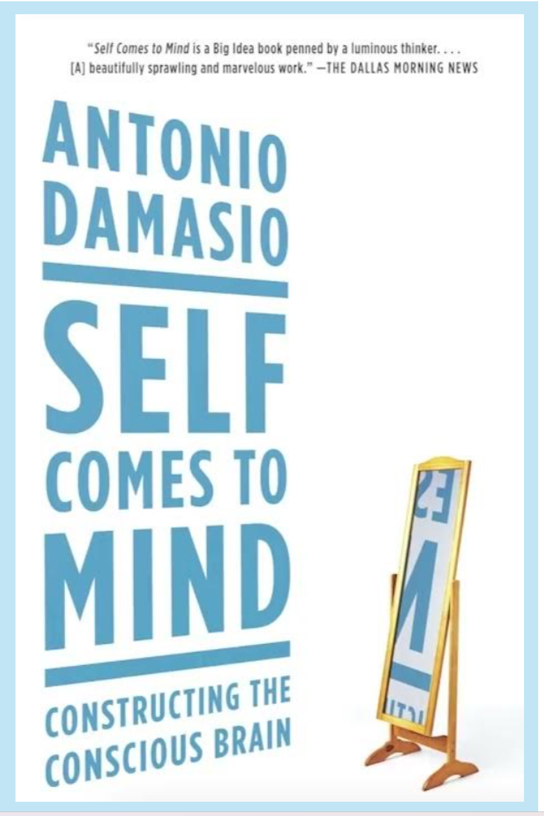
In this work, Antonio Damasio traces the emergence of consciousness from the body’s internal rhythms. He begins with the protoself, a silent mapping of the organism’s state, and moves through the core self, where interaction sparks awareness, to the autobiographical self, where memory and imagination braid into identity. It’s a progression that feels both biological and mythic: a layering of presence into personhood.
What stayed with me was not just the model, but the tone. Damasio writes with precision, but also with reverence, for the body, for the pulse beneath cognition, for the quiet intelligence of feeling. His view of the self as a process, not a possession, helped clarify my own sense of identity as recursive, participatory, and always in motion.
In Fractal Universe, I describe the Sparksphere as a living structure, one that metabolizes experience through tension, attention, and resonance. Damasio’s work offered a grounding parallel: the idea that consciousness is not imposed from above, but emerges from within, layer by layer. His concept of the autobiographical self helped me name a dynamic I now call Autobiographical Recursion, the way memory loops through meaning, shaping coherence across time.
Damasio doesn’t claim to solve the mystery of consciousness, but he illuminates its contours with care. For those of us mapping invisible dynamics, whether through neuroscience or metaphor, his work offers a kindred orientation: one that honors complexity without abandoning clarity.
Recommended for readers exploring urban design, memetic influence, and the hidden costs of technological dominance.
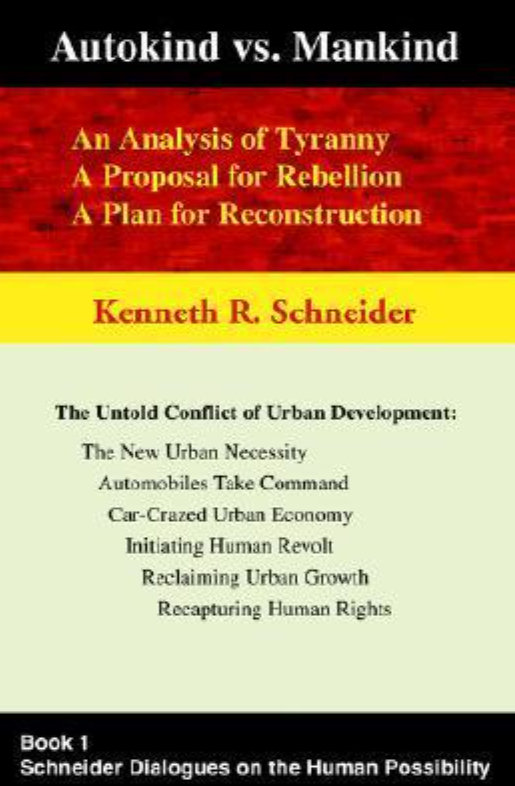
In Autokind vs. Mankind, Kenneth R. Schneider delivers a bold critique of automobility, not merely as a mode of transport, but as a cultural force that reshapes cities, citizenship, and human experience. Written in 1971, the book traces the automobile’s evolution from “the toy of the rich” to “the necessity of the poor,” ultimately becoming “the deprivation of all”. Schneider argues that the automotive empire has distorted urban environments, monopolized movement, and eroded the human scale of life.
His analysis goes beyond traffic and pollution. Schneider exposes how automobility limits access, isolates individuals, and transforms public space into corridors of consumption. He calls this dynamic a form of tyranny, one that demands rebellion and reconstruction. The automobile, in his view, is not just a machine but a meme: a self-replicating cultural force that thrives on attention, reshapes values, and consumes resources at the expense of human flourishing.
For Fractal Universe, Autokind vs. Mankind was a revelation. It illuminated the Human Atmosphere as a memetic ecosystem, an invisible field of culture, history, and collective attention where ideas, technologies, and social currents compete for vitality. Within this atmosphere, memes like the automobile can thrive parasitically, drawing energy from human lives while offering diminishing returns.
Schneider’s critique helped illustrate that cultural ecosystems require active participation, not passive immersion. Just as we need shelter from physical elements, we need memetic discernment to navigate the Human Atmosphere.
For readers of Fractal Universe, Schneider’s work offers a vivid example of how memes shape environments, and how individuals must apply intelligence, creativity, and resistance to restore human-scale coherence. It’s not just about rejecting the automobile; it’s about recognizing the memetic architecture of our world and choosing how we engage with it.
Recommended for readers exploring language, abstraction, and the architecture of human understanding.
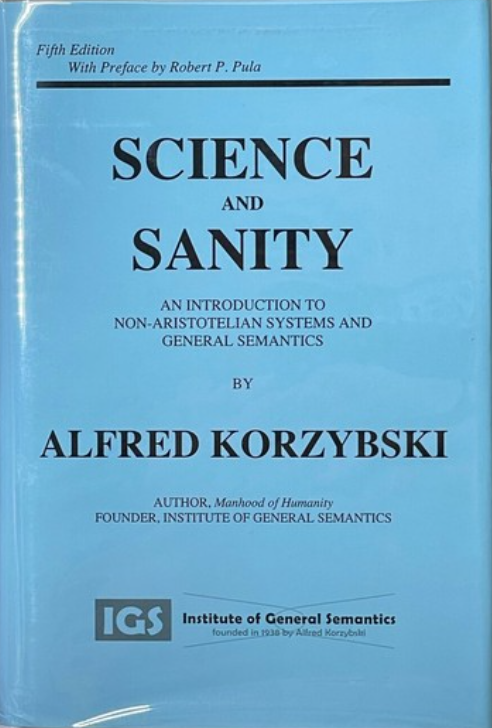
First published in 1933, Science and Sanity is Alfred Korzybski’s magnum opus, a dense, interdisciplinary work that introduced the field of General Semantics. Korzybski argued that human perception is shaped not by direct contact with reality, but by layers of abstraction filtered through language, nervous systems, and cultural constructs. His famous dictum, “The map is not the territory,” reminds us that our representations of reality are not reality itself.
At the heart of the book is the Structural Differential, a visual metaphor for abstraction. It depicts how experience moves from the event level (raw reality) to increasingly abstract layers: sensory impressions, descriptions, inferences, and symbolic representations. With each step, something is inevitably left out. This omission isn’t just quantitative, it’s qualitative. The nature of what remains shifts. Korzybski’s insight is that sanity, clarity, and effective communication depend on recognizing these shifts and navigating them consciously.
Korzybski’s Structural Differential became a conceptual bridge for Fractal Universe. Its recursive abstraction mirrors fractal dynamics: each level of reality is a self-similar echo of the one before, yet qualitatively distinct. In the Fractal Universe framework, this is vividly illustrated by the transition from the Human Atmosphere, a collective field of history, myth, and cultural resonance, to the individual human, shaped by personal lineage and local context.
Just as Korzybski showed that abstraction filters reality, Fractal Universe reveals that each scale of being metabolizes meaning differently. The Sparksphere, like the Structural Differential, is a recursive unit of coherence, one that evolves through tension, resonance, and dimensional emergence. Korzybski’s work affirmed that clarity is not found by collapsing complexity, but by honoring the nested structure of reality and the qualitative shifts between layers.
For readers of Fractal Universe, Science and Sanity offers a foundational lens: a way to see abstraction not as distortion, but as a necessary, and navigable, feature of human experience.