Monthly Archives: August 2025

The Four Noble Truths of Love by Susan Piver

In The Four Noble Truths of Love, Susan Piver offers a refreshingly honest and spiritually grounded lens on romantic relationships. Drawing from Buddhist philosophy, she reframes love not as a refuge from suffering, but as a path of awakening. Her truths, relationships never stabilize, expecting them to fix us creates suffering, love is a spiritual path, and practice is essential, invite readers to meet love with presence, courage, and compassion.

Piver’s approach is gentle yet radical. She doesn’t promise harmony; she offers clarity. Her reflections help us embrace the instability of love as a teacher, not a flaw.

In Fractal Universe, love is not a static state, it’s a dynamic field of resonance, fission, and recursive becoming. Piver’s truths echo the Sparksphere’s arc of transformation: instability as invitation, suffering as signal, and relationship as a mirror for alignment. Her work affirms that love, like all fractal structures, is not meant to be solved, it’s meant to be lived, observed, and refined.

Hardwiring Happiness by Dr. Rick Hanson

Suggested for readers exploring neuroplasticity, emotional integration, and the architecture of inner strength.

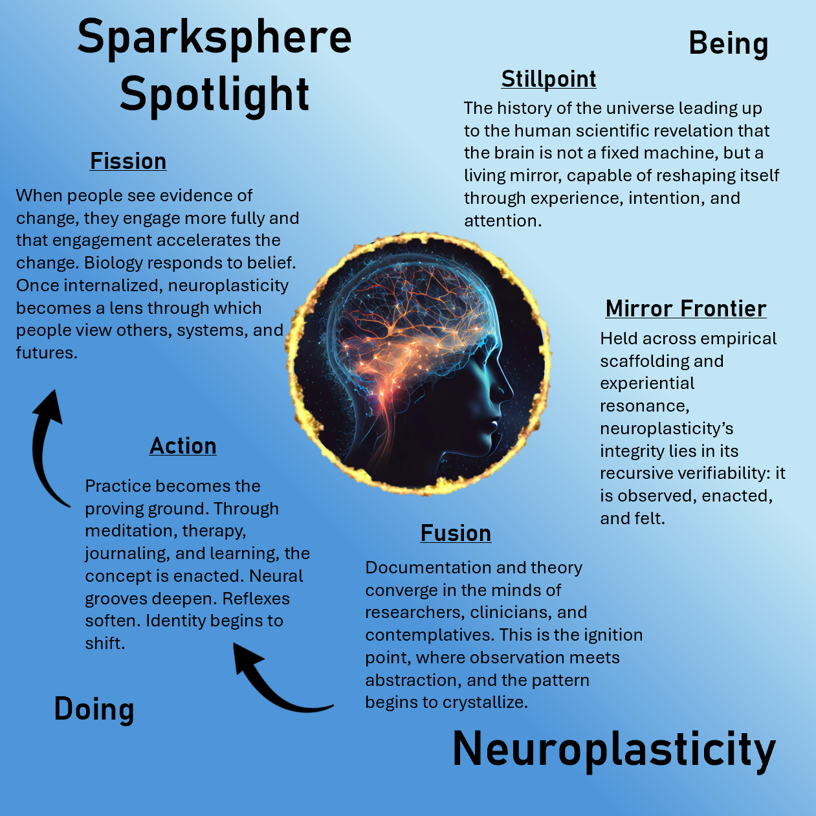
In Hardwiring Happiness: The New Brain Science of Contentment, Calm, and Confidence, Dr. Rick Hanson offers a practical guide to rewiring the brain through positive neuroplasticity. Drawing from neuroscience and contemplative practice, Hanson teaches readers how to internalize beneficial experiences, turning fleeting moments of peace, joy, and connection into lasting traits.

This book is both scientific and soulful. Hanson’s “taking in the good” method invites readers to slow down, savor, and absorb positive states, allowing the nervous system to reshape itself from the inside out. His approach is gentle, empowering, and deeply aligned with experiential growth.

In the context of Fractal Universe, Hanson’s work echoes the Sparksphere’s arc of Fusion–Action–Fission. His practices embody the principle of recursive encoding, where attention becomes architecture, and belief becomes biology. Like the Fractal Universe framework, Hardwiring Happiness invites readers to participate in their own becoming.

“The brain is like Velcro for negative experiences and Teflon for positive ones. But you can change that.” —Rick Hanson

Klan-Destine Relationships by Daryl Davis

A courageous inquiry into fear, identity, and the power of human connection.

In Klan-Destine Relationships, Daryl Davis, a Black musician and race relations expert, shares his extraordinary journey of engaging with members of the Ku Klux Klan. What began as a quest to understand racism became a living experiment in empathy, dialogue, and transformation. Through face-to-face conversations and unexpected friendships, Davis witnessed dozens of individuals renounce their hate and leave the Klan.

This book is not a prescription, it’s a provocation. Davis doesn’t preach; he listens. His story invites readers to confront their own assumptions, explore the roots of fear, and consider what it means to build bridges across seemingly impossible divides.

In the context of Fractal Universe, Davis’s work exemplifies the principle of resonant disruption, where presence and inquiry dissolve inherited patterns. His method echoes the Fractal Universe emphasis on motivational geometry and invisible dynamics: how belief systems calcify, and how they can be softened through relational recursion.

“When two enemies are talking, they’re not fighting.” —Daryl Davis

The Complete Enneagram: 27 Paths to Greater Self-Knowledge by Beatrice Chestnut

A map of personality, a mirror for transformation.

Beatrice Chestnut’s The Complete Enneagram: 27 Paths to Greater Self-Knowledge offers a profound expansion of the classic Enneagram framework. By introducing 27 instinctual subtypes, Chestnut reveals the nuanced ways our core motivations shape behavior, relationships, and inner life.

This book is ideal for readers seeking more than surface-level insight. Chestnut’s approach is both psychologically rigorous and spiritually attuned, guiding readers through the shadows and gifts of each type with clarity and compassion.

In the context of Fractal Universe, Chestnut’s work resonates as a living geometry of identity. Her subtypes spiral outward like fractal petals, each one a unique expression of a deeper pattern. Both frameworks invite us to observe, reflect, and realign with our core essence.

“The Enneagram is not just a map of personality—it’s a guide to waking up.” —Beatrice Chestnut

Everything is Spiritual by Rob Bell

Suggested for readers exploring cosmic belonging, spiritual integration, and the hidden architecture of meaning.

Rob Bell’s Everything Is Spiritual is a luminous invitation to see the universe, and ourselves, as part of a living, unfolding story. Blending personal memoir with expansive cosmology, Bell traces his journey from religious tradition to spiritual spaciousness, revealing how grief, wonder, and scientific insight can shape a deeper understanding of who we are and what we’re doing here.

This book is not a doctrine, it’s a dialogue. Bell weaves quantum mechanics, ancient theology, and emotional honesty into a tapestry that affirms: everything belongs. From the thirteen-billion-year expansion of the cosmos to the quiet ache of family loss, he shows how every moment is infused with significance, and how spirituality is not separate from life, but embedded within it.

Readers drawn to Fractal Universe will find resonance in Bell’s approach. His reflections mirror the Sparksphere’s recursive nature, where personal experience echoes cosmic pattern, and inner transformation ripples outward. Similar to the fractal framework, Bell invites us to participate in reality as a living geometry of meaning.

“You’re not a mistake. You’re not a problem to solve. You’re not a disruption in the force. You are a story unfolding.” —Rob Bell

Science and The Stillness

Science is often described as the study of motion, energy, and change. But beneath every experiment, every equation, and every observation lies something quieter, something foundational. That something is The Stillness.

You may not call it that, but you depend on it every day. When you hold a variable constant, when you define a reference frame, when you isolate a system, calibrate an instrument, or balance an equation around an equals sign, you are shaping The Stillness into form.

The Stillness is not the absence of motion. It is the condition that makes motion meaningful. It is the silent geometry that allows comparison, coherence, and causality to emerge. Without The Stillness, there is no baseline, no symmetry, no repeatability. It is the unmoving center that gives movement its context.

In the Fractal Universe, The Stillness is not just a convenience, it is the origin. It is the dimensionless substratum from which every Sparksphere arises. And while science may not measure it directly, it is always present, beneath the lab bench, behind the data, within the structure of thought itself.

This is not a challenge to science. It is an invitation to recognize the metaphysical elegance already embedded in your work. You are not just predicting outcomes, you are orienting reality. And orientation begins with energy’s counterpart, The Stillness.

Apply & Observe:

As you engage in your next experiment or analysis, pause and ask:
Where am I invoking Stillness?
What must remain steady for this inquiry to unfold?
How does Stillness shape the meaning of what moves?

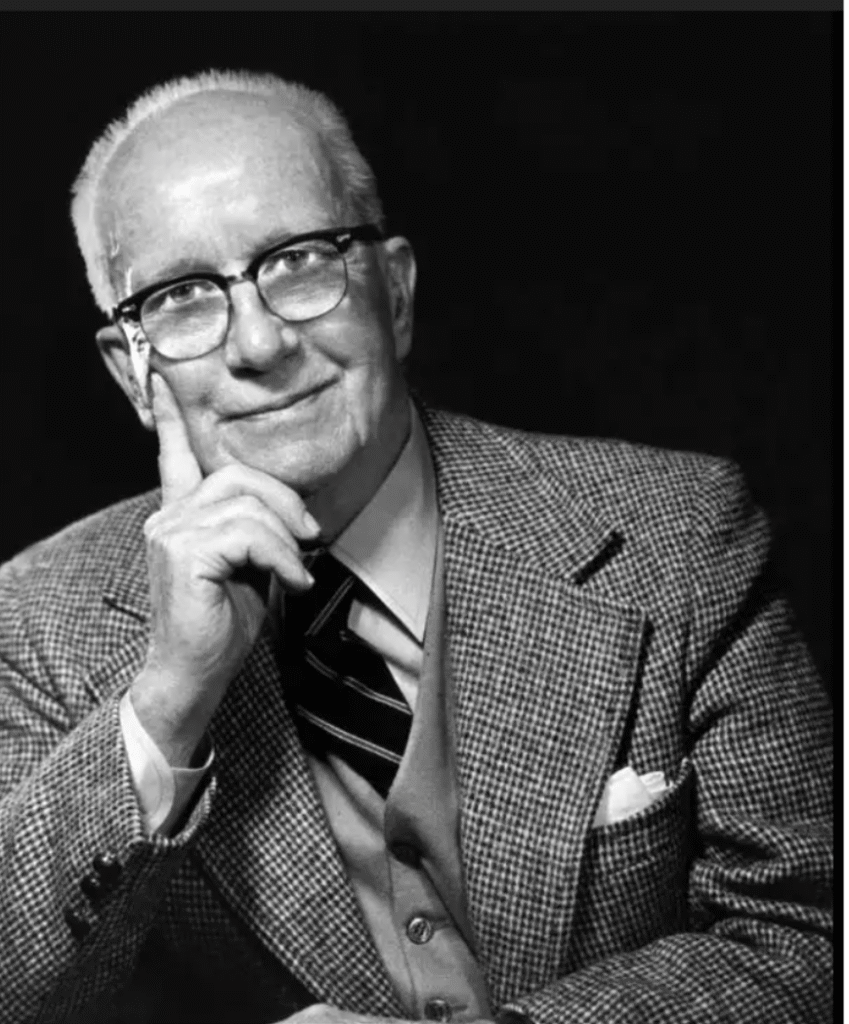
“Unity is plural and, at minimum, is two.”- Buckminster Fuller

Buckminster Fuller’s Duotet reminds us that unity is not the absence of difference, but the presence of relationship. Two tetrahedra interlock, not to erase each other, but to form a stable whole.

In the Fractal Universe, this principle echoes through every Sparksphere: Being and Doing, Stillness and Motion, Self and Other. Unity is not static; it’s a living pattern of resonance.