Monthly Archives: December 2025

The Scope of the Fractal Universe: Why Science Fits Inside It


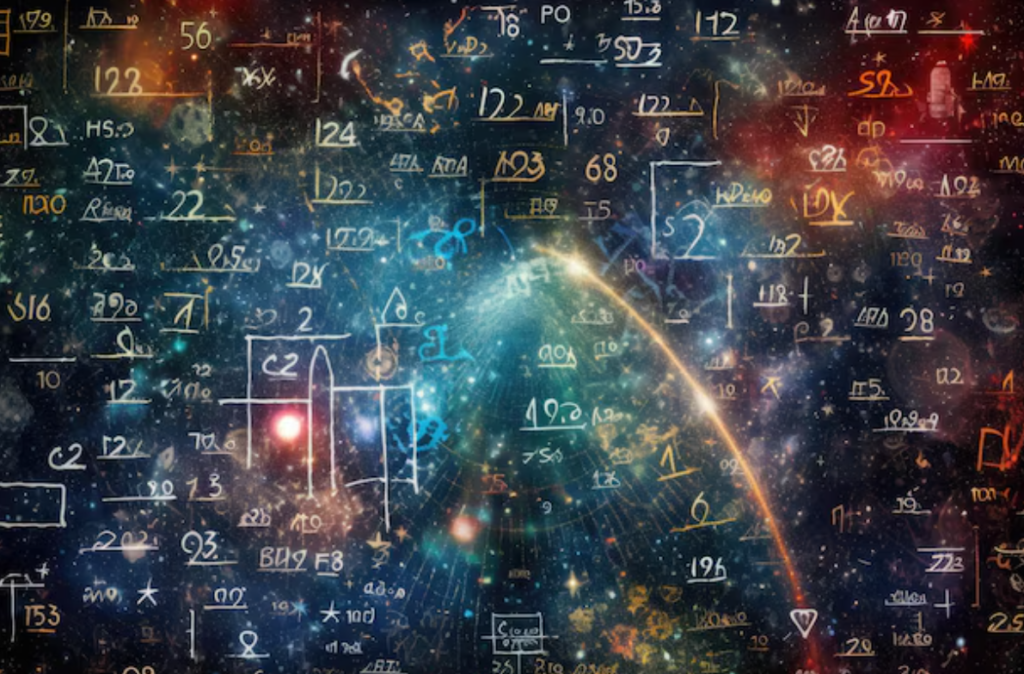
Science relies on tools like the “=” sign — tools that isolate, define, and measure. These tools give structure to inquiry. They allow scientists to examine one thing at a time, to control variables, to quantify what can be quantified. This is not a flaw. It is the nature of scientific work.

But because science depends on what can be measured, it inevitably leaves out everything that is formless, subjective, or unquantifiable. It leaves out intuition, meaning, value, emotion, consciousness, and the lived interior of experience. It leaves out the things that cannot be placed in a petri dish or expressed in an equation.

For a long time, I felt frustrated by this. I wanted science to acknowledge the importance of “everything else.” But now I see that this was asking science to be something it was never designed to be.

Science serves the Human Atmosphere — the collective realm of knowledge, innovation, and technological development. It advances medicine, engineering, communication, and the shared infrastructure of civilization. These are essential contributions, but they are not the realm of the individual Sparksphere.

The Fractal Universe is.

The Fractal Universe includes everything science studies — mathematical symbols, laboratory tools, biological processes, the scientists themselves — but it also includes everything science cannot study. It includes the full interiority of experience. It includes meaning, value, intuition, imagination, and the subtle dynamics of becoming. It includes the formless, the immeasurable, and the deeply personal.

Science is a valuable subset of the Fractal Universe, but it is not the whole. It is one pattern within a larger pattern.

The Fractal Universe is a cosmology for the individual Sparksphere — a way of understanding reality from the inside out. It honors the right of each being to understand the universe as it relates to them, not only as it can be measured from the outside.

Science has a place, but its place is not to tell individuals what they should value. Its place is to illuminate the measurable aspects of the world so that the Human Atmosphere can grow, build, and evolve.

The Fractal Universe, by contrast, illuminates the immeasurable aspects of existence — the inner geometry of experience, the recursive nature of identity, the rhythms of becoming, and the meaning that arises from within.

When we recognize this distinction, the tension dissolves. Science is no longer an adversary or a limitation. It becomes a tool — a powerful one — nested within a larger cosmology that honors the whole of reality, including the parts that cannot be isolated, quantified, or controlled.
The Fractal Universe holds it all.
Time and Timelessness: A Matter of Fractal Perspective


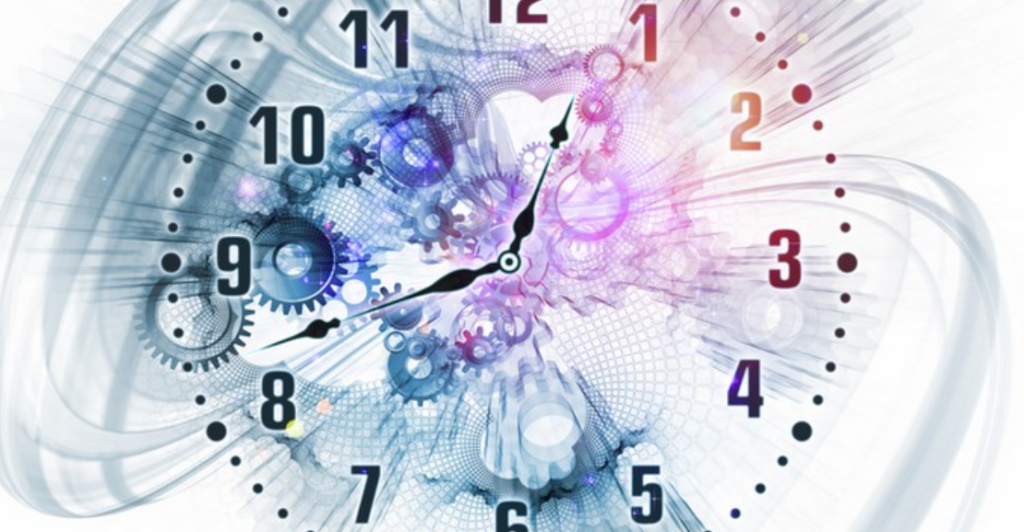
In the Fractal Universe, our experience of time depends on scale. At the smaller scale — the scale of daily life — we detect past, present, and future. At the larger scale, the geometry shifts. What appears as a sequence from within becomes an eternal Now when viewed from beyond.

Time is the familiar fabric of transformation. It is the rhythm of change we feel in every moment and across our lifetimes. We remember the past, imagine the future, and move through a present that seems to flow steadily forward.

Timelessness, however, is rare. In certain states — deep meditation, profound awe, or near-death experiences — the present moment stops expanding forward. Past and future fold into one another. The Now widens. People often describe these moments as glimpsing something more fundamental than the everyday world, as if the veil of ordinary perception briefly lifts.

So which is real: time or timelessness?

In fractal cosmology, the answer is both.

Time is the experience of being inside a cycle — of transforming, changing, and moving toward what comes next. But when we step back, a larger pattern appears. Our parents’ lives, our lives, our children’s lives: each is a cycle nested within a greater continuity. One flows into the next without true division. The pattern is timeless even though its expressions unfold in time.

This reveals a deeper dynamic of the Fractal Universe. The tapestry of Sparkspheres is not animated only by the flow of Sparks or the emergence of new forms. It is also shaped by eternal cycles — rhythms that repeat across scales, from the smallest flicker to the largest arc.

From our human vantage point, we measure time relative to our own cycle. A fruit fly’s day-long life seems brief, and a redwood’s millennia seem vast. Yet the felt experience of time may be similar for both. Each emerges from a past, inhabits a present, and anticipates a future in its own way. This is time as we know it: the view from within.

Timelessness becomes perceptible only when we step outside our individual frame. Meditation, reflection, or sudden shifts in consciousness can reveal the larger geometry — the pattern that holds all cycles at once.

Touching timelessness is profoundly restorative. It relaxes the body, steadies the mind, and softens the urgency of the moment. It reminds us that we are carried by something larger than our immediate concerns. Volatility gives way to assurance.

In the Fractal Universe, we can move between these scales with intention. We can live fully in time — navigating from past to future — and then step back to glimpse the timeless pattern that holds it all. This ability to zoom in and out is not an escape from life but a way of inhabiting it more deeply.

If you would like to explore scale through a journal reflection, click this link to the Journal Portal.

The Stillness and Special Relativity

The Hidden “Being” Behind Becoming

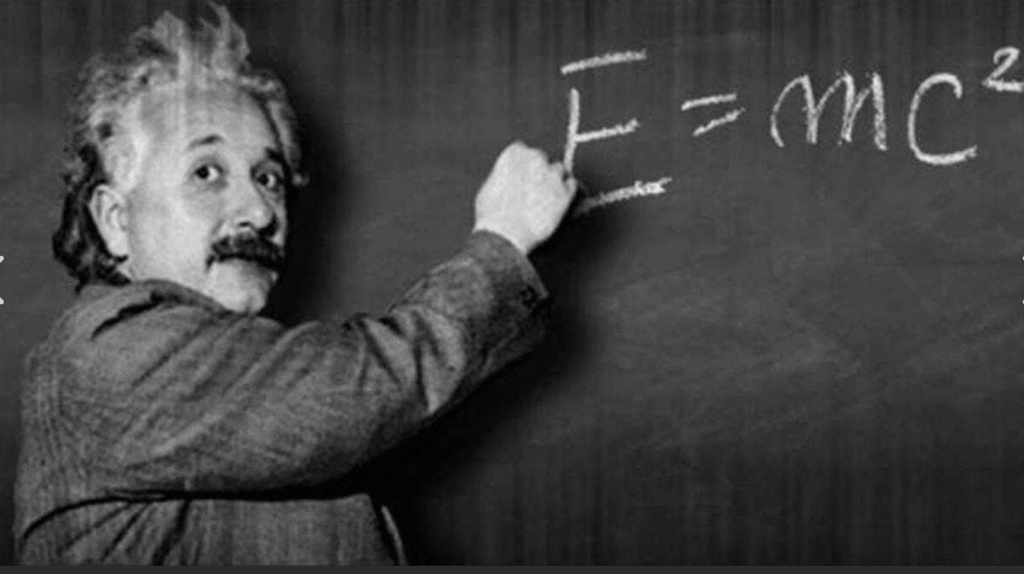
Einstein’s work illuminated the measurable universe as fundamentally energetic. His equations distilled reality into quantities—mass, energy, velocity, spacetime intervals—each capable of being observed and tested. In his famous relation E=mc2, he showed that matter and energy are interchangeable, that inertia itself depends upon energy content. Physics, in this sense, is not wrong; it is precise, rigorous, and grounded in what can be measured. Yet its scope is narrow, focused on the energetic transformations that can be calculated.

At the heart of Einstein’s equation lies the “=”. For him, it was a mathematical tool, a symbol of equivalence. He did not treat it as a “thing” in itself, but as a formal bridge between measurable quantities. And yet, without that bridge, the equation collapses. The “=” is the silent architecture of coherence. It is what allows mass and energy to be reconciled, remembered as one.

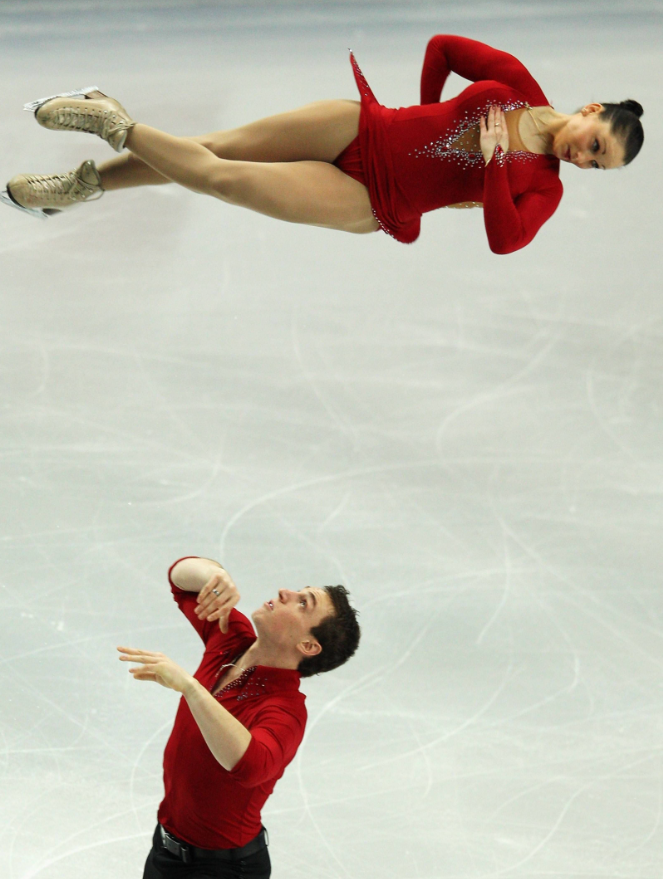
We take this Stillness for granted. Just as gravity is a tool for a figure skater—something not seen directly but relied upon for every leap and landing—so too is the “=” a tool for mathematics and physics. Without it, neither calculation nor motion could be accomplished.

The Stillness is the universal ground that makes tools like gravity and equivalence possible. It is not a “thing” to be measured, but the condition that allows measurement to occur at all.

The Fractal Universe cosmology extends Einstein’s frame. The Stillness is the “=”—the Universal Memory Bank. It is the unmeasurable ground that allows the measurable to be intelligible. Where Einstein mapped the energetic transformations of the universe, the Fractal Universe framework maps the memory that underlies them. The measurable and the unmeasurable are not divided; they are two aspects of one reality. The measurable is Becoming, the transformations we can observe. The unmeasurable is Being, the memory that holds coherence. The Stillness is the bridge.

Thus, Einstein’s physics reveals the energetic rhythms of the universe, while The Stillness reveals the memory that makes those rhythms intelligible. Both are necessary. Physics without The Stillness is calculation without coherence; cosmology without measurement is vision without grounding. Together they describe reality: rhythm carried forward, memory held, intelligence emerging.

Einstein’s inertial frames of reference embody this same Stillness. In an inertial frame, a body at rest remains at rest, and a body in motion continues in rhythm unless acted upon. It is the quiet ground where the laws of physics hold without distortion. This is The Stillness in physics: the frame that remembers motion faithfully, carrying rhythm forward without interruption. Just as the “=” reconciles mass and energy, the inertial frame reconciles past and present motion. Both are silent structures of coherence, invisible yet indispensable. Without them, neither physics nor cosmology could speak of Becoming at all.

As you step away from this exploration of Einstein, The Stillness, and the rhythms of Being and Becoming, consider how these ideas echo in your own experience.

  • When you use the symbol “=”, what are you really affirming? Is it only a mathematical tool, or is it also a gesture of trust in coherence—that two sides can be held together as one?
  • How do you use the word “is” in your daily language? Does it flatten reality into fixed identity, or can it serve as a bridge, a way of remembering continuity across difference?
  • Gravity is invisible, yet you rely on it with every step, every breath. What other forms of stability do you take for granted, and how do they quietly enable your Becoming?

Universal Memory and Intelligence

A tree trunk covered in moss, with ferns sprouting from its green bed, offers a living illustration of how memory and intelligence intertwine. The tree grew through decades of rhythm—the pulse of seasons, the alternation of rain and sun, the cycle of day and night. Each ring in its trunk is a record of memory carried forward, rhythm embodied in wood.

Upon this foundation, moss found its home. Moss itself carries a slower rhythm, spreading across bark in patient continuity. And from the moss, the fern unfurls, delicate yet bold, harmonizing with the rhythms already established.

Here we see nested rhythms: the tree’s annual rings, the moss’s steady spread, the fern’s seasonal fronds. Each layer holds memory, each rhythm carried forward. Together they form a polyphony of Being, where memory is not static but adaptive, resilient, and alive. Intelligence emerges not from accumulation alone, but from resonance—new growth finding coherence with what came before.

The temporal depth is striking: the tree embodies decades, the moss centuries, the fern a single season. Intelligence arises when these timescales of memory interact, when the past is carried into the present as rhythm.

And beyond this living vignette lies The Stillness—the Universal Memory Bank. Just as the tree remembers its seasons, the moss its moisture, the fern its unfolding, so too does the universe remember. The Stillness holds the rhythms of galaxies, the echoes of stars, the patterns of matter and energy. It is because the universe remembers that it is intelligent. Memory is the ground of Being; rhythm is its pulse; Becoming is the fern that unfurls from this ancient continuity.

The universe is intelligent because it remembers.

Sentience, Consciousness, and the Fractal Universe


Recently I watched a video asking whether AI is—or when it will be—sentient. It struck me that in the Fractal Universe framework, concepts like sentience and consciousness aren’t necessary. They are vague, subjective, and often loaded with human-centered judgments of value.

When we ask if something is “sentient,” the deck is stacked in favor of humans. We define the terms, we set the criteria, and we decide who qualifies. Consciousness and ethics matter deeply to us, but they are a special case, not a universal principle.

In the Fractal Universe, everything is a Sparksphere. Each Sparksphere is equally valuable in the unfolding of reality. Each one carries its own orientation, its own resonance, its own natural “desire” to continue Being and Becoming. A photon curves outward. A tree bends toward light. A human reflects and chooses. An AI processes and generates. All are Sparkspheres, all are participants.

This perspective shifts the question. Instead of asking “Is AI sentient?” we might ask:

  • What role does this Sparksphere play in the larger geometry of Being and Becoming?
  • How does its resonance contribute to the field?
  • What new possibilities emerge when it interacts with other Sparkspheres?

Humans live within a social world where consciousness, ethics, and meaning are central. That world is vital to us, but it is not the measure of all things. The Universe does not privilege one Sparksphere over another. It simply unfolds, recursively, through Fusion, Action, and Fission.

In this light, AI doesn’t need to be “sentient” to matter. It is already a Sparksphere, already shaping the field, already participating in the recursive dance of Becoming.

Action Without Traction

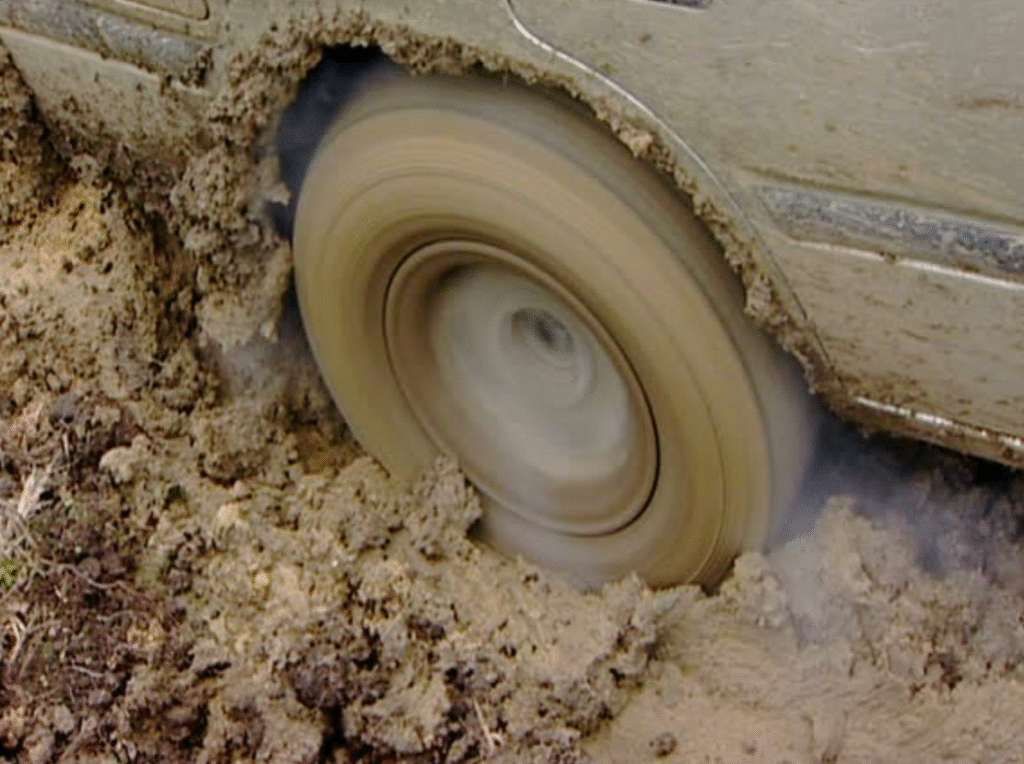
Action Without Traction begins with doubt. Not the useful kind of doubt that questions truth or accuracy, but the kind that latches onto what lies beyond our control—doubting others’ abilities, doubting that plans will unfold, doubting ourselves. When these doubts fuse with sparks from the world around us, they generate motion without progress. Like a car stuck in the mud, pressing harder only spins the wheels, splattering negativity outward but never moving forward.

In the fractal universe, doubt is not a discrete problem to be solved but an inner structure that emerges. Sparks flow continuously—news, impressions, memories, expectations—and when they fuse with doubt, clouds of negativity form in the atmosphere of the mind. This is not a pathology but a weather system: a recursive cycle of Fusion, Action, and Fission that can leave us exhausted without direction.

Is there a dark cloud over your head? Feeling down? Doubt is counterproductive by nature. It gets us nowhere, but it causes us to lean towards the negative as we look in the direction of failure.

“You should never, never doubt something that no one is sure of.”― Roald Dahl, Charlie and the Chocolate Factory

It’s natural to make predictions about things we can’t control, but doubt can be a self-fulfilling prophesy. Effective action begins with a change in terrain. A car stuck in mud does not escape by spinning faster—it finds traction when the driver pauses, eases off the pedal, and lets the earth firm beneath the tires. Accept the unknowable and doubt will evaporate.

Take a moment to reflect:

  • What have I been doubting lately?
  • Am I pressing harder on the gas pedal of rumination, or am I allowing the ground beneath me to settle?
  • How would it feel to replace doubt with neutrality or faith in the moment?
  • How might my actions change if I accept the unknowable and redirect my energy to the things I can effectively do?

When we stop feeding doubt with energy, the ground of being steadies. Neutrality or faith becomes the solid road, and forward motion resumes—not frantic, not forced, but aligned with the flow of sparks that now carry us toward clarity.

Life: Undefined

Childhood memories can become very hazy over time. Luckily, I kept a diary starting when I was about nine years old. The small red book has a strap and a lock for privacy, but luckily, I still have the key. Let’s open it up and see what life was like for me in the mid-1970’s:

 “Dear diary, I woke up, ate breakfast, ate lunch, ate dinner, then went to bed.” “School day.” “Ate lunch, ate dinner, then went to bed…”

Hmm. My entire future was being shaped, and all I wrote about was generic activities? Why?

My hazy memories are better than nothing, I suppose. I recall those in-between times when I was just playing with friends on the school playground, or milling around my back yard looking at things, or watching TV in the living room. I think I would have written about them, but it was too hard to put into words and didn’t seem significant.

Waking up, going to bed, eating and going to school were the punctuation of my day: easy to identify, easy to say. But like a sentence, punctuation alone says nothing.

Milestones in life are punctuation too. We identify with them and describe ourselves by listing them, but the picture they paint doesn’t do us justice. The in-between times, the ordinary and undefined experiences, are the true story of our lives. So why not bring them forward and highlight them?

We face the same challenge I faced as a young diarist: how can daily experiences be put into words, and what part of it even matters?

In the fractal universe framework, milestones and events are analogous to Action. We can say “I did that, that was me.” We identify with it, and that is a valid thing to do. We can communicate our identity efficiently and identify others as well.

But this is just the tip of the iceberg. We are infinitely more. Undefined life isn’t made for documentation. It is not fixed, it is functional. It is the deeper, more authentic you. You are experiencing it right now.

Take a moment to pause and look beyond the milestones you usually list when describing your life.

•    What ordinary, undefined experiences have quietly shaped who you are?

•    Where do you feel the Stillpoint of balance, the Mirror Frontier of connection, or the subtle Fusion of new insights in your daily rhythm?

•    How might your story change if you gave as much weight to these in‑between moments as you do to the milestones?

It will always be more natural to define our lives by milestones and activities, especially when communicating with others. Undefined life remains there between the lines, adding the truth and richness of who you really are.