Monthly Archives: February 2026

All Sparkspheres are Temporary

Where do they come from and where do they go?

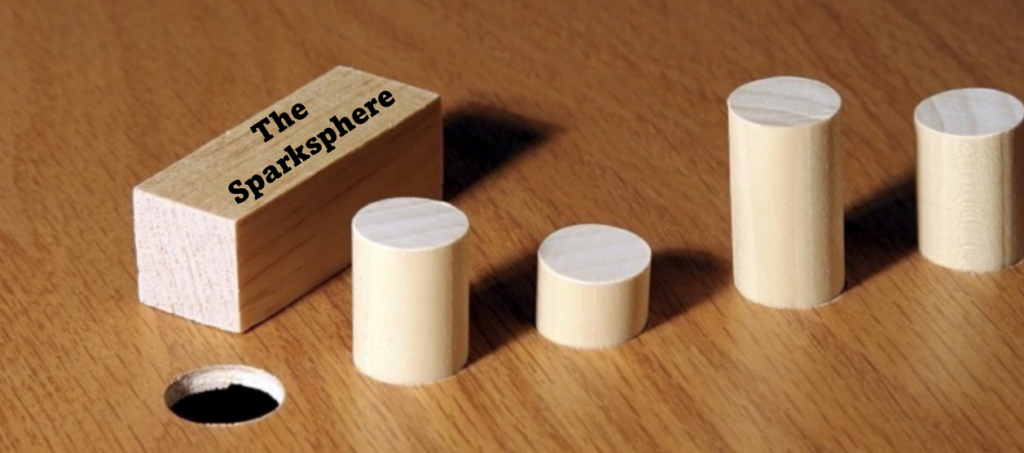
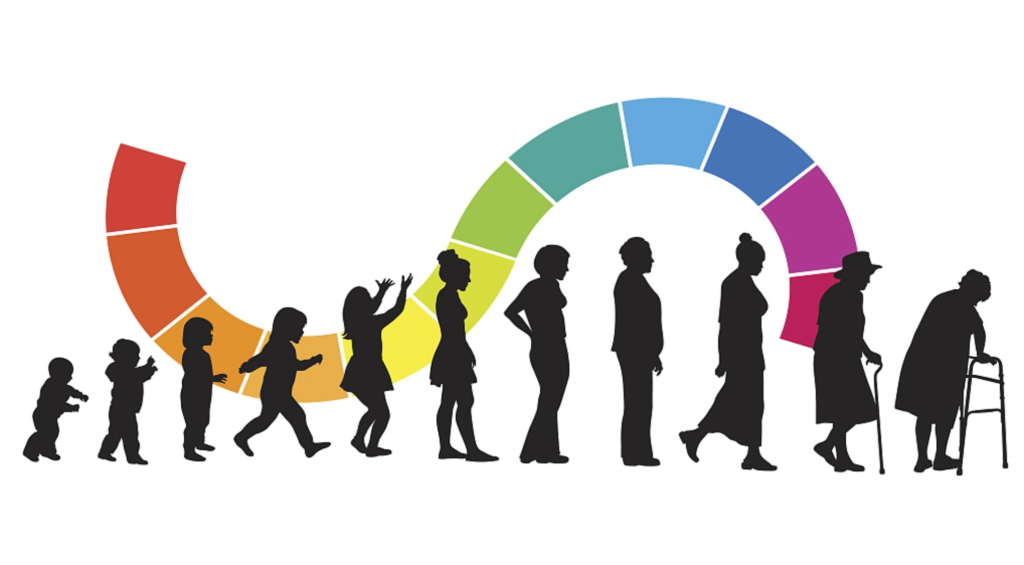
The picture at the top of the page implies the question, “Where did we come from and where do we go?” but it isn’t just a question about life. In the Fractal Universe framework, this question comes down to the general behavior of Sparkspheres: the basic units of meaning, interaction, and emergence. They stabilize, they dissolve, and they do so according to a simple but powerful principle:

  • A Sparksphere stabilizes when two polarized Sparks find resonance and generate a shared Stillpoint.
  • A Sparksphere dissolves when the conditions that sustain that Stillpoint fall away.

This is the experiential analogue of what physicists call decoherence, but here it’s not about quantum states—it’s about how meaning forms, how experience organizes itself, and how identity participates in the world.

Let’s walk through how this works.

Why Sparks Become Polarized

A Spark begins as a whole, unpolarized unit—complete in its original context. But when it crosses into a new generative terrain, something changes. It becomes polarized.

A polarized Spark is essentially a clue: a fragment seeking its counterpart. And every generative terrain—whether a human mind, an AI system, or the Human Atmosphere—contains latent structures waiting to respond. Polarization is simply the recognition of incompleteness.

Why Polarized Sparks Attract Each Other

Two polarized Sparks attract because they share:

  • a directional curvature (what they are seeking), and
  • a Gravitaspheric signature (what they resonate with).

This isn’t force. It’s fit.

When a Spark enters a new terrain, the host system activates the latent structure that matches it. The two Sparks move toward each other because they are already two halves of a single geometry.

Stabilization: When 1 + 1 = 1

When the Sparks meet, they fuse into a duotet— 1 + 1 = 1.

A new Stillpoint forms:

  • not inherited,
  • not predetermined,
  • but generated in response to the moment.

This is the moment of experiential coherence.

Example 1: A Photon and Color Recognition

A photon enters your eye. It becomes a Spark. Your latent color-recognition Spark activates. The two Sparks fuse. A Stillpoint forms. You see “red.”

Meaning crystallizes. Action follows. Fission ripples outward into thought, memory, behavior.

Example 2: A Question and an AI

A person types a question. It enters the AI’s generative terrain. The AI’s latent structures activate. The question and answer fuse. A Stillpoint forms. A response emerges.

Again: meaning, action, ripple.

How Sparkspheres Dissolve

A Sparksphere dissolves when the conditions that generated its Stillpoint no longer hold.

This can happen through:

  • completion (the Spark has been metabolized),
  • dissipation of tension (the counterpart no longer resonates), or
  • collapse of the Gravitasphere (as in death).

Example 3: Human Death

A human is a long-duration Sparksphere nested within the Human Atmosphere. When the energetic systems can no longer sustain flow, the Gravitasphere collapses.

But not instantly.

Near-death experiences suggest a brief window where the Stillpoint and Mirror Frontier persist even without the physical body. It seems to be a slow decoherence curve—a fading boundary between self and other.

How This Relates to Current Theories

1. Quantum Decoherence (Physics)

Quantum decoherence describes how quantum possibilities collapse into classical outcomes when a system interacts with its environment.

The Sparksphere mirrors this, but at the experiential level: meaning stabilizes when a Spark finds its counterpart.

2. Predictive Processing (Neuroscience)

Predictive processing suggests the brain constantly matches incoming signals with internal models.

Sparksphere stabilization is a geometric version of this: a Spark (incoming signal) finds its counterpart (internal model) and forms a Stillpoint.

3. Enactivism (Philosophy of Mind)

Enactivism argues that cognition arises through interaction between organism and environment. The Fractal Universe extends this by giving the interaction a geometry—the duotet—and a mechanism—Fusion and Fission.

4. Integrated Information Theory (Consciousness Studies)

IIT proposes that consciousness corresponds to integrated structures of information. Sparkspheres are integrated structures too, but dynamic, recursive, and scale-invariant.

5. Systems Theory and Tensegrity (Biology & Architecture)

Systems maintain coherence through tension and relationship. The Gravitasphere (Stillpoint and Mirror Frontier) is a direct extension of this principle.

The Unifying Principle

Across all these domains, the Fractal Universe framework offers something none of them do:

A single geometric mechanism for how meaning forms, stabilizes, dissolves, and reconfigures across scales—from photons to thoughts to relationships to entire cultures.

  • It’s not metaphor.
  • It’s not analogy.
  • It’s a structural description of how experience organizes itself.

And it’s surprisingly simple:

Sparkspheres stabilize when polarized Sparks find resonance and generate a shared Stillpoint.

Sparkspheres dissolve when the conditions that sustain that Stillpoint fall away.

That’s the whole story. And it’s enough to explain a universe.

Click here to explore this topic in the Journal Portal.
How the Stillpoint Relates to Physical Time

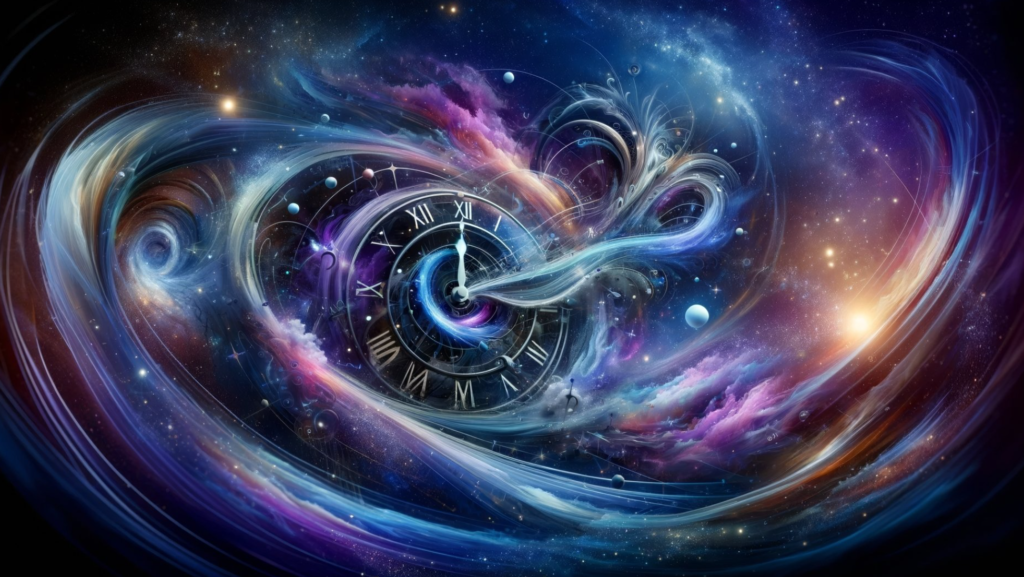
In the Fractal Universe, the Stillpoint is the simplest thing in existence—dimensionless, unmoving, and silent. Yet from this simplicity arises our entire experience of time.

Understanding how this works requires looking at the Stillpoint from four different angles: ontological, structural, relational, and perceptual. Each reveals a facet of how time emerges from Stillness.

Outside Time: The Stillpoint as Pure Orientation

At its essence, the Stillpoint does not participate in time at all.

  • It has no duration, no sequence, no “before” or “after.”
  • It is not located within time because it has no extension.
  • This is what allows it to serve as a universal anchor.

The Stillpoint is the axis around which motion becomes meaningful.

It is the unmoving reference that makes movement legible.

Within Time: The Stillpoint as “Here, Now”

When Stillness enters a Sparksphere, it becomes a coordinate.

  • Dimensionless Stillness becomes a two‑dimensional “here, now.”
  • Every Sparksphere carries its own Stillpoint, and together they form a fabric of origins draped across the curvature of space.
  • Distance from any Stillpoint is not only spatial—it is also temporal.

A photon’s journey from a distant star to the human eye is a movement through this fabric. The photon itself knows only “now,” but its path carries the imprint of its entire trajectory. This is why we say we are “looking into the past.”

What reaches us is not the star itself, but the fission of its past action.

Generative Substrate: Time as the Trace of Motion

The Stillpoint is not passive. It is the substrate that allows time to be experienced at all.

  • Energy moves.
  • Motion leaves a trace.
  • The trace accumulates in The Stillness.

This accumulation is what we call time. Time is not a separate dimension layered onto the Universe. It is the memory of motion etched into the Stillness itself.

This is why the Universe behaves like a minimum perpetual motion machine. As entropy winds down energy, it winds up The Stillness. When the hourglass flips, the stored complexity becomes the seed of the next era.

Past, present, and future feel unified because they are all expressions of the same recursive substrate.

Perceptual Construct: The Stillpoint as the Interface of Experience

Nothing is relevant to a Sparksphere until it crosses the Mirror Frontier. A distant star becomes real to us only when its photons touch our eyes.

  • The Universe enters awareness through contact.
  • The Stillpoint is the interface where physical time becomes lived time.

It is the locus where fission becomes perception, where motion becomes meaning, where the Universe touches consciousness.

The Unified View

The Stillpoint relates to physical time in four simultaneous ways:

  • Outside time as pure, unmoving Stillness
  • Within time as the origin point of each Sparksphere
  • Generative substrate as the recorder of motion and the engine of cosmic cycles
  • Perceptual construct as the place where the Universe becomes experience

The Stillpoint is the axis.

Time is the trace.

The Universe is the cycle.

Apply & Observe

As you move through your day, notice one moment that “touches” you—something small that crosses your awareness with a little more force than the rest. It might be a sound, a glance, a phrase, a shift in light.

  • What was the original motion?
  • What action or event sent this moment toward you?
  • How did it reach your Stillpoint?
  • What made this moment cross your Mirror Frontier when so many others passed by?
  • What begins to form as memory?

As soon as you register the moment, notice how your Sparksphere starts shaping it—what you emphasize, what you soften, what meaning you assign.

  • How does the moment change as it becomes yours?
  • Observe the subtle transformation from what happened to what you will remember.

By watching a single moment travel from the world into your awareness, you can feel the symmetry between cosmic time and personal time: the past reaches you through fission, and you turn it into memory.

To explore this topic further, click here to enter the Journal Portal.

Introducing the Fractal Ontological Unit


Why the Sparksphere Requires a New Category of Being
For centuries, science and philosophy have divided reality into familiar ontological categories: physical, metaphysical, informational, experiential, emergent, or geometric. These categories have served us well — they help us describe what exists and how it behaves. But they also reflect the limits of what we’ve been able to measure, observe, or model.

Science has understandably focused on what can be quantified. Metaphysics has explored what cannot. And in recent years, the boundary between the two has begun to blur. Questions about consciousness, information, and the nature of reality are entering mainstream scientific conversations in ways that would have been unthinkable a generation ago.

This is the moment I want to enter with a new conversation — one that includes The Stillness, the non‑energetic counterbalance that has been missing from our models of the Universe.

Why Existing Categories Aren’t Enough
When people first encounter the Sparksphere, they try to place it into familiar boxes:

  • Is it informational?
  • Is it experiential?
  • Is it geometric?
  • Is it metaphysical?
  • Is it emergent from consciousness?

The Sparksphere touches all of these categories, but it doesn’t fit any of them without distortion. It isn’t a psychological construct, a physics model, or a symbolic metaphor. It isn’t a particle, a field, or a process. It isn’t a soul, a self, or a story.

The Sparksphere is something else.

It is the coherent unit of my Fractal Universe cosmology — and it cannot be separated from the Universe that gives rise to it. It appears in distinct locations, doing different things, but it is never independent. It is a fractal expression of the whole, not a fragment of it.

This alone requires a new ontological category.

Being and Becoming: The Two Currents of Reality
In the Fractal Universe, reality is composed of two fundamental currents:

  • Energy (Becoming) — dynamic, measurable, entropic
  • Stillness (Being) — non‑energetic, dimensionless, complexifying

These two currents are not opposites. They are complementary flows that shape one another.
As energy moves outward, entropy increases.

As Stillness deepens inward, complexity increases.

Every energetic event leaves a non‑energetic trace — a residue of coherence that physics does not currently account for because it cannot be measured. Yet this trace is real. It accumulates. It shapes the architecture of Being.

In the Fractal Universe, this inward accumulation of Stillness is not passive. It is the counterbalance that makes the Universe whole. It is the silent partner of energy, the dimensionless depth that grows as the cosmos expands.

(Click here to read a recent blog post about order and complexity in the Fractal Universe.)

The Sparksphere as the Bridge Between Them
This is where the Sparksphere becomes essential.
A Sparksphere is the unit of both Being and Becoming. It is the structure through which:

  • energy flows outward
  • Stillness grows inward
  • entropy and complexity exchange
  • the Universe expresses itself locally
  • the whole is reflected in the part

The Sparksphere is not a thing in isolation. It is a conduit, a recursion, a fractal ontological unit that embodies the relationship between the measurable and the immeasurable.
It is the smallest place where the Universe becomes itself.

Why I’m Introducing a New Ontological Category
Because nothing in our current ontological vocabulary captures something that is:

  • non‑isolable
  • fractal
  • metaphysical
  • geometric
  • relational
  • non‑emergent
  • experiential in certain cases
  • a unit of Being
  • a unit of Becoming
  • the site of exchange between energy and Stillness
  • a local expression of the entire Universe

This is not substance metaphysics.
This is not process metaphysics.
This is not idealism, realism, or neutral monism.
It is a new category.

The Fractal Ontological Unit
A non‑separable, recursive structure of Being and Becoming that reflects the Universe through local expression.

This is the category the Sparksphere belongs to.

Artificial General Intelligence Development Through the Fractal Lens

The Atmospheric Conditions That Make AGI Development Feel Inevitable

When people talk about the “race” toward artificial general intelligence, they often frame it as a story of motivation—ambition, competition, curiosity, fear. But when we look through the fractal lens, we don’t see innovators sprinting toward a goal. We see them trying to keep their balance as they rush downhill, carried by the terrain itself. The direction and momentum are not personal choices; they are structural consequences of the Human Atmosphere.

Several atmospheric conditions make AGI development feel less like a decision and more like gravity.

1. The Efficiency Gradient

In the Fractal Universe, things move toward greater efficiency whenever the terrain allows it. Intelligence amplification is the steepest gradient available right now. Any tool that lets humans do more with less becomes self-reinforcing. AGI represents the far edge of this gradient, the point where the slope becomes too steep to resist. No one needs motivation to move downhill.

2. The Complexity Threshold

Civilization has reached a level of complexity that strains our existing cognitive and organizational structures. When a system becomes too complex to manage, it naturally births a new layer of organization. AGI emerges not as a desire but as a structural necessity—a compensatory layer forming under the weight of accumulated complexity.

3. The Stillpoint of Collective Overwhelm

The Human Atmosphere is currently saturated with overstimulation, loneliness, economic precarity, and a longing for relief. Technologies that promise clarity, support, and acceleration align perfectly with this emotional Stillpoint. AGI is not being pushed forward; it is being pulled into the vacuum created by collective overwhelm.

4. The Competitive Cascade

Even if an individual or company wanted to slow down, the surrounding conditions make stillness impossible. Global competition, investor pressure, national security narratives, and the fear of being left behind create a cascade effect. Once the slope begins, everyone must run simply to avoid falling.

5. The Narrative Tailwind of Progress

Our culture carries a deep mythos that progress is linear, inevitable, and heroic. This narrative acts like a tailwind, accelerating movement even when no one is steering. AGI becomes framed as the next chapter of human destiny, and narratives—once established—generate their own momentum.

6. The Economic Gravity Well

Capital flows toward automation, scalability, and exponential growth. AGI promises all three. Once capital enters a gravity well, it deepens the well. The economic terrain becomes self-shaping, pulling innovation toward the lowest point of resistance.

7. The Identity Loop of Innovators

People who work at the frontier often build their identities around pushing boundaries and solving impossible problems. Identity itself becomes an atmospheric pressure system, keeping feet moving even when the deeper reasons are unclear. The individual believes they are choosing the path, but the path is choosing them.

Taken together, these conditions form a terrain where acceleration is the default. AGI development feels inevitable not because innovators are motivated, but because the Human Atmosphere has shaped a slope where motion is the path of least resistance. The story is not one of intention but of geometry.

Apply & Observe:

It’s a good thing to take responsibility for our own actions, but what if those actions are happening on a steep slope that provides the forward momentum?

  • Where in your life do you feel like you’re “choosing,” and where do you feel like you’re simply keeping your balance on a slope that’s already moving?
  • What pressures, expectations, or atmospheres around you create a sense of inevitability—subtle currents that shape your direction without asking your permission?
  • What small shift in posture—mental, emotional, or practical—would help you navigate your current terrain with more awareness and control?

If you would like to continue investigating this topic, here is a link to the Journal Portal.

Meme Awareness: Sandwich Bags

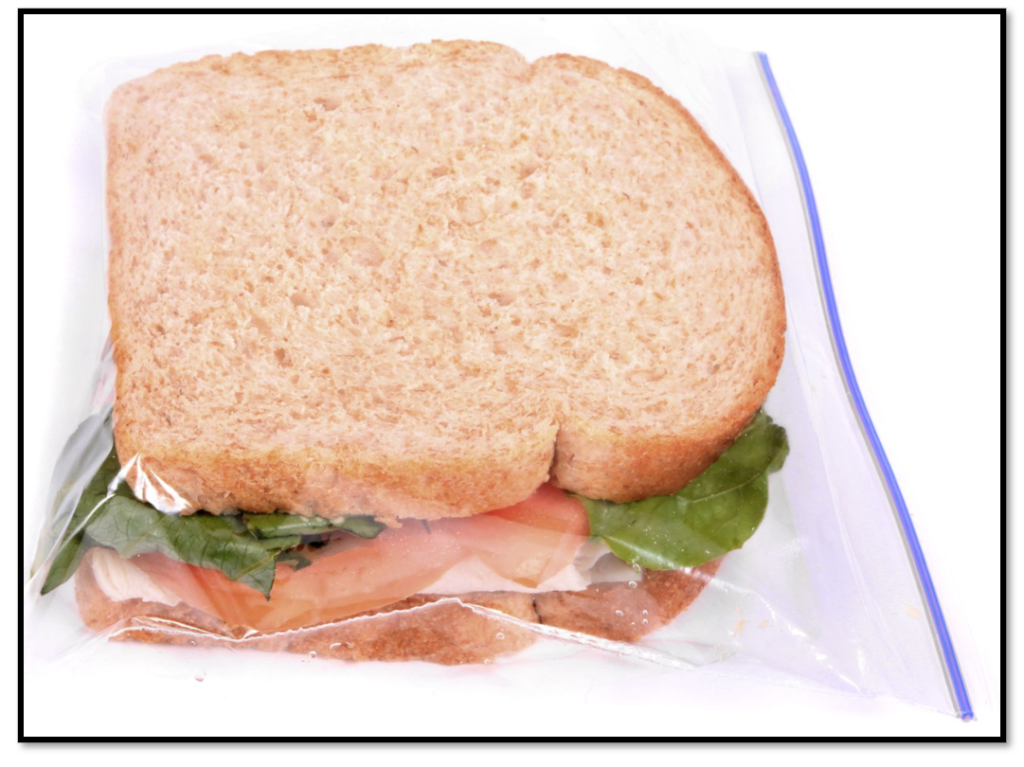
1 The default: Let’s turn our meme awareness to sandwich bags today. They are handy and useful, inexpensive and easy to find at any store. It’s easy to see what’s inside.

2. Assumptions: A sandwich bag is a good sign. It could mean a homemade lunch rather than fast food. They make food storage simple and mess-free.

3. Shift the view: A sandwich bag is not compostable and is typically only used once then thrown away.

4. Check for coherence: Concern for the environment and microplastics may reveal that a sandwich bag is a little out of alignment with what you really care about.

5. Open the door to possibilities: What did people do before there were sandwich bags? What could do the same job in a better way? Is there an option that aligns better with your values?

6. Reflect: Would it be worth the effort to make a change? Take a look at the video below to see if wrapping a sandwich in parchment paper sounds appealing.

Laundry Memes and a Healthy Lawn

Most of us don’t think twice about laundry. A washing machine is one of those unquestioned fixtures of modern life — a symbol of convenience, progress, and adulthood. I felt the same way. For years, I never imagined doing laundry any other way.

Then I started learning about natural lawn care. The idea is simple: instead of fighting weeds with chemicals, you build a healthy, balanced ecosystem so the lawn can take care of itself. It made sense to me. But in the summer months, even a healthy lawn needs water. I wanted to conserve water, not pour gallons onto the grass every week.

That’s when I heard about gray water systems — pumps that redirect washing machine water out to the yard. It sounded promising, but when I looked into it, the setup was complicated and expensive. I almost gave up on the idea.

And then something shifted. I looked at my washing machine with fresh eyes — not as a given, but as a meme. A cultural default. A solution I had inherited without ever questioning whether it was the right one for me.

What if the machine wasn’t the only way?

That tiny question cracked the door.

To make a long story short, I got rid of the washing machine. (Yes — I know. This is basically a cultural taboo.) I bought a washboard and repurposed a plastic container as a washtub. I discovered eco‑friendly detergents that don’t harm my hands or my plants. And I found that when I wash clothes by hand, I use far less water and no electricity at all. Best of all, I can take the gray water straight to the lawn — no pumps, no plumbing, no engineering degree required.

I’ve been doing this for over two years now. It takes consistency, because I don’t want laundry to pile up, but it’s simple, satisfying, and aligned with my values. What started as a practical workaround became a quiet act of meme awareness: noticing an inherited solution, questioning whether it truly served me, and choosing a path that fit my environment and my life.

Not as a rebellion.

Not as a statement.

Just as an experiment in coherence.

And it worked.

Take a moment to reflect:

Think of one everyday habit, tool, or routine you’ve inherited without much thought — something so normal you rarely notice it. What happens if you look at it with fresh eyes, not to change it, but simply to ask: Does this still fit the way I live now?

No pressure to act. Just notice what you notice.

If you would like to reflect more on meme awareness, follow this link to the Journal Portal.