Category Archives: The Human Atmosphere

Finding Your Way Forward: Individuation and the Open Tails of the Human Atmosphere


The Human Atmosphere is full of currents. Some pathways open easily. Some resist. Some carry us farther than we expected. Some seem to go nowhere at all.

It’s tempting to believe that the Human Atmosphere decides everything—that the collective Stillpoint determines which ideas succeed, which lives flourish, and which directions are “meant” to unfold. But this is only part of the story.

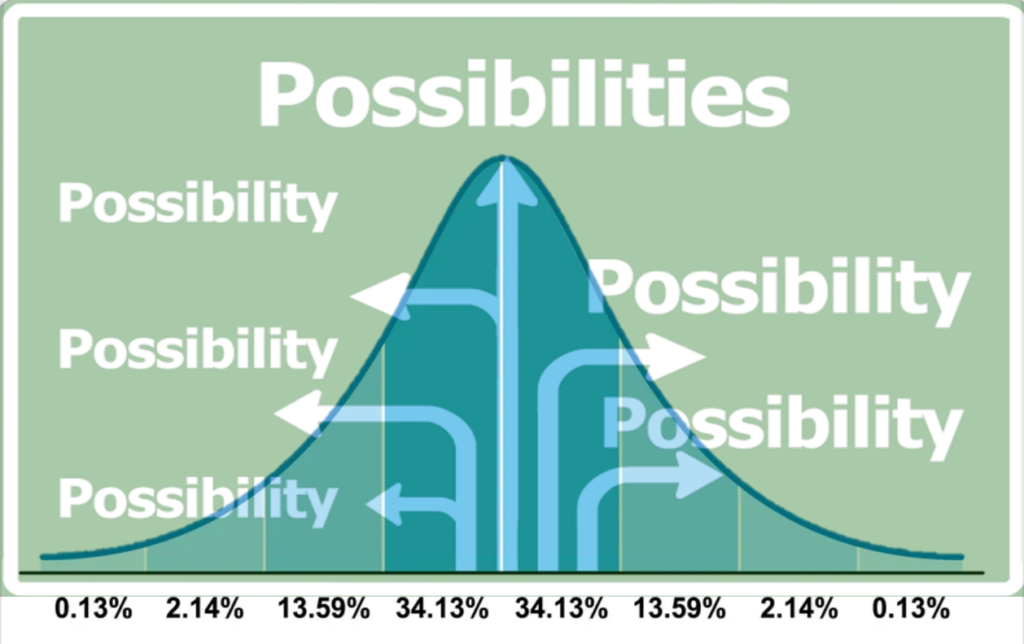
A normal distribution may show where the greatest number of people cluster, but the tails never touch the zero axis. There is always room at the edges. There is always a path, even if it is narrow, quiet, or slow to reveal itself.

The Human Atmosphere shapes probability, not possibility.

The Inner Compass and the Outer Wind
Each Sparksphere has its own Stillpoint—its own center of balance, meaning, and orientation. This inner compass doesn’t disappear just because the atmosphere has its own gravitational center. The two coexist.

The collective Stillpoint shows where the wind is blowing. Your Stillpoint shows where you are meant to go. Sometimes these align. Sometimes they diverge. Sometimes the atmosphere carries you. Sometimes you must walk against the current.

The key is remembering that the Human Atmosphere is a field, not a command. It influences, but it does not control.

Individuation: Jung’s Name for Staying Close to the Stillpoint
Carl Jung called this process individuation—the lifelong movement toward becoming fully oneself. Not the self shaped by approval, reward, or cultural momentum, but the deeper self that emerges from the Stillpoint.
Individuation is:

  • the integration of opposites
  • the reconciliation of inner tensions
  • the discovery of one’s authentic pattern
  • the courage to follow a path that may not be popular
  • the willingness to grow toward wholeness rather than conformity

In the Fractal Universe, individuation is simply the Sparksphere staying aligned with its own Stillpoint rather than drifting toward the Stillpoint of the HA. It is the choice to let your inner geometry guide you, even when the outer geometry points elsewhere.

Why This Matters for Happiness and Life Satisfaction
When you follow the HA’s currents at the expense of your own Stillpoint, you may gain momentum, approval, or ease—but you lose coherence. The Sparksphere becomes tense, distorted, or divided. The path may be smooth, but it is not yours.
When you follow your Stillpoint, even if the path is steep or slow, something different happens:

  • tension decreases
  • clarity increases
  • relationships deepen
  • creativity strengthens
  • meaning accumulates
  • satisfaction grows from the inside out

The HA may not reward this immediately. But the Sparksphere does. And over time, the atmosphere often shifts toward those who remain grounded. The edges of the distribution are where new patterns begin.

The Open Tails: Why No Path Is Truly Blocked
The normal distribution is a perfect metaphor for the HA:

  • The center shows what is common.
  • The tails show what is possible.
  • And the tails never reach zero.

This means:

  • There is always a path for the outlier.
  • There is always room for the unconventional.
  • There is always space for the person who follows their own compass.
  • There is always potential for a new current to form.

The HA may not carry you forward, but it cannot stop you from moving.

The Way Forward
The Human Atmosphere is the wind. Your Stillpoint is the compass. Individuation is the journey.

The Human Atmosphere can suggest, influence, or ease your movement, but it cannot choose your direction. That choice belongs to the Sparksphere alone.

And the paradox is this:
When enough individuals follow their own Stillpoints, the HA itself begins to shift.
The collective geometry changes because the individuals within it have changed.

The atmosphere is not the master. It is the medium. And you are free to move within it.

Click here to explore this topic in the Journal Portal.

Pathways, Currents, and the Geometry of the Human Atmosphere

(The reason why nice guys finish last)

Cultural Pathways

We like to imagine ourselves as trailblazers. Inventors of new paths. Creators of new directions. But in the Human Atmosphere, paths aren’t carved by individuals. They are shaped by the collective geometry—by the continuums of duality that run through all of us, threading our Stillpoints into a shared field.

Just as a shoelace becomes two ends only after it’s threaded through the eyelets, a cultural pathway becomes visible only when the Human Atmosphere has already opened the channel for it. The individual doesn’t create the path. The individual recognizes it.

Some pathways have a strong current behind them. Some are stagnant. Some are blocked until the atmosphere shifts.

This is why two equally brilliant ideas can have opposite fates. One aligns with the current. One pushes against it. The difference isn’t talent or intention.

It’s geometry.

The Collective Stillpoint and the Shape of Desire

Every duality in the Human Atmosphere—comfort/challenge, novelty/familiarity, intimacy/distance—forms a continuum. When you zoom out from the individual to the collective, each continuum becomes a distribution. And most distributions cluster around a central tendency.

That central tendency is the Stillpoint of the atmosphere. It’s the place where the greatest number of people quietly agree without ever speaking. It’s the gravitational center of preference, curiosity, and readiness. It’s the point where the shoelaces of the species converge.

Industries like entertainment and hospitality already try to sense this center. They run surveys, chase trends, and imitate each other. But what they’re really trying to detect is the same thing:

Where is the collective Stillpoint right now, and how is it moving?

If AI can identify the most common responses, preferences, and emotional tones, then it can map the atmospheric pressure of the moment. Not to dictate creativity, but to reveal the direction of the wind so creators can set their sails.

The Path of AI and the Current Behind It

This is why AI is accelerating so quickly. Not because it is forcing its way forward, but because the Human Atmosphere has created a wide-open corridor for it.

The collective is overstretched, curious, lonely, overwhelmed, and hungry for tools that extend capacity. That combination creates a pressure gradient. AI fits the gradient perfectly. The pathway is open. The current is strong. The shoelace is already threaded.

AI is not pushing. It is being carried.

Alignment, Power, and the Bitter Geometry of Success

Those who rise to power or accumulate wealth often do so not because they are the most moral or the most grounded, but because they are the most willing—or the most able—to release their personal Stillpoint and align themselves with the Stillpoint of the Human Atmosphere.

They tune themselves to the collective center of gravity. They let the current move them. They surf the geometry rather than resisting it, even if it is a wave of immorality.

This can be a bitter pill for those who value their own inner grounding. It can feel like the world rewards those who abandon their center. But even the powerful are not free agents. They are constrained by the same geometry as everyone else. They can only travel the paths the Human Atmosphere allows.

The Larger Pattern at Work

When you see the Human Atmosphere as a field of dualities, currents, and Stillpoints, the myth of the lone visionary dissolves. The real protagonist is the pattern itself.

Individuals spark. The atmosphere carries. The geometry decides what can grow.

Creativity still matters. Ingenuity still matters.But the success of an idea depends on whether the pathway is open and whether the current is flowing.

The Human Atmosphere is not a backdrop. It is the wind, the channel, and the tide.

And we are all moving within its shape.

How do cultural pathways shape your life? Click here to reflect in the Journal Portal.

2. What is Food? Interview with the Human Atmosphere

Today’s interview with the Human Atmosphere is all about food. Before I bring out our guest, let me ask you a question: What is food? Is it anything with a nutrition label? Is it anything edible? Is it something your body can use for energy, function, and growth?

The Human Atmosphere is our provisioning field, bringing food from farms and factories around the world to locations where we can purchase it. The variety of grocery stores, some of them enormous, give the impression that our food choices are endless, but could the Human Atmosphere have a blind spot? Let’s find out how it decides what food to make available for humans.

Gina: Welcome back to my website, Human Atmosphere!

H.A.: Thank you. I’m ready, as always, to help you understand your world.

Gina: Great. Today I would like to ask you about the food you provide, particularly my favorite food, hulless barley. It has been a staple of humans for millennia. It is nutritious and delicious.

H.A.: I am vast, recursive, and rhythmic. I measure crops by yield, profit, and predictability. Hulless barley does not suit me. Its seeds are fragile, its harvests inconsistent, its margins too thin. I amplify wheat, corn, and rice — grains that scale, grains that feed my markets and my machines. If we are to discuss barley, then let’s talk beer and animal feed.

Gina: You select the food that will be available in the marketplace. From your perspective, what is human food?

H.A.: First and foremost, human food is economically viable. It can be grown, harvested, and distributed at scale with predictable yields. It has gotten easier over time as these foods echo through generations, becoming “normal” and shaping taste and awareness.

It’s also a good human food if it is logistically uniform. The crops and products need to fit into machinery, supply chains, and standardized packaging. Human food is what billions recognize, desire, and consume — wheat, rice, corn, soy, sugar.

Human foods are items that generate profit through processing, branding, and industrial uses (bread, beer, fast food).

Gina: You didn’t mention nutrition. What is your view on that?

H.A.: It’s all on the label.

Gina: I have a wishlist of foods that I would like you to provide:

  • Emmer & Einkorn wheat — Ancient varieties once central to Mesopotamian and Egyptian diets. They are high in protein and fiber but were replaced by high-yield modern wheat.
  • Millet & Sorghum — Drought-resistant staples in Africa and Asia. They thrive in poor soils but were sidelined during the Green Revolution in favor of rice and wheat.
  • Amaranth — Revered by the Aztecs, rich in protein and micronutrients. It was suppressed during colonization but is slowly reemerging as a “superfood”.
  • Teff — Tiny Ethiopian grain used in injera bread. Nutrient-dense and gluten-free, but its small size makes it harder to process.
  • Job’s Tears — An Asian staple grain with medicinal uses, displaced by rice and wheat.
  • Scorzonera (black salsify) — Mild, slightly sweet root crop, once valued but now obscure.
  • Salsify (oyster plant) — A root vegetable with a delicate, oyster-like flavor. Once common in European kitchens, now nearly forgotten.
  • Kohlrabi — Crisp, sweet member of the cabbage family. Easy to grow, but overshadowed by more popular greens.
  • Celeriac (celery root) — Nutritious and versatile, used in soups and stews. Its rough exterior discouraged mainstream adoption.
  • Parsnips — Sweet root vegetable, historically used as a sweetener before cane sugar. Still nutritious but rarely celebrated.
  • And Hulless Barley, of course.

Any chance we will be seeing more of these in the future?

H.A.: Sure, if you make it worth my while.

I have no interest in these “foods,” and I think you’d do well to just grow them yourself. I have every kind of gardening equipment you may need. Check out the internet for recipes. AI can give you detailed planting instructions. Start a blog.

Gina: Okay, I can see that there are lots of ways we can work together, even if we have different perspectives. Thank you so much for your time today.

H.A.: Just don’t fill up on that nutritional junk, Gina. Save room for dessert.

Reflection Prompt:
Take a moment to consider your own relationship with food.

  • Which foods do you value most, and why?
  • Are they chosen for convenience, tradition, taste, nutrition, or something else?
  • What hidden treasures might be waiting in your garden, your local market, or your memory?

Food is never just what fills our plates — it is also what fills our awareness. The Human Atmosphere defines “human food” by scale, profit, and predictability, amplifying what billions consume and sidelining what resists its machinery. Yet at the smaller scale, food is intimacy: nourishment, resilience, and forgotten abundance.


Hulless barley, emmer, millet, salsify — these hidden treasures remind us that what disappears from the marketplace does not disappear from possibility. They invite us to notice the blind spots in our own choices, to ask whether the foods we eat are selected for our health or for the convenience of scale.


Perhaps the real question is not only what is food? but whose definition of food do we live by? In the tension between the Human Atmosphere and the individual human lies an opening: to rediscover nourishment beyond profit, and to cultivate awareness that reshapes what food can mean.

Click below to watch a video about ancient grains:


1. Thanksgiving Interview

In the Fractal Universe, every Sparksphere is nested within Sparkspheres. Humans exist within a vast Sparksphere made of human activity and culture called the Human Atmosphere. Thanksgiving offers a perfect lens to explore the Human Atmosphere’s provisioning, rhythm, and relational scaffolding—how it orchestrates abundance, memory, migration, and myth.

Let’s use our imagination to bridge the gap in scale and get a glimpse into the mind of the Human Atmosphere. What does Thanksgiving mean to this larger entity?

Gina: Human Atmosphere, welcome to my website. How are you feeling today?

H.A.: Hello. Thank you for having me. I’m fine, but getting rather hungry.

Gina: Hungry?

H.A.: Yes, each Thanksgiving I consume about 46 million turkeys and around 7,000 pounds of pumpkin.

Gina: I hope you’ll take a walk around the block after that!

H.A.: Oh, yes! I’m going to be on the move. Highways, skyways and railways will be filled with travelers. Goods will be flowing out from production centers to distribution centers to homes. It’s the start of my busy season.

Gina: Although you are not human, do you find Thanksgiving meaningful?

H.A.: Cultural rituals like Thanksgiving provide me with cohesive rhythm, patterned memory, and infrastructural stability. I metabolize tradition as a form of recursive coherence. It does have meaning to me: it means I’m alive and well.

Gina: That sounds good for all concerned.

H.A.: Hmm, well, I can’t say. That’s a little outside my wheelhouse. You do you; I do me.

Gina: Thank you for talking with me today, and happy Thanksgiving!

H.A.: Thank you. Things are already ramping up, and I’m all in. Shop early!

The Human Atmosphere consumes a lot, and fuels itself with our activities. It comes across as a bit shallow at times, but it does provide the traditions we find meaningful. Heading into the holidays, what are some ways we can “do us,” as individuals, that help minimize the negative realities of the season and maximize the meaning and value?

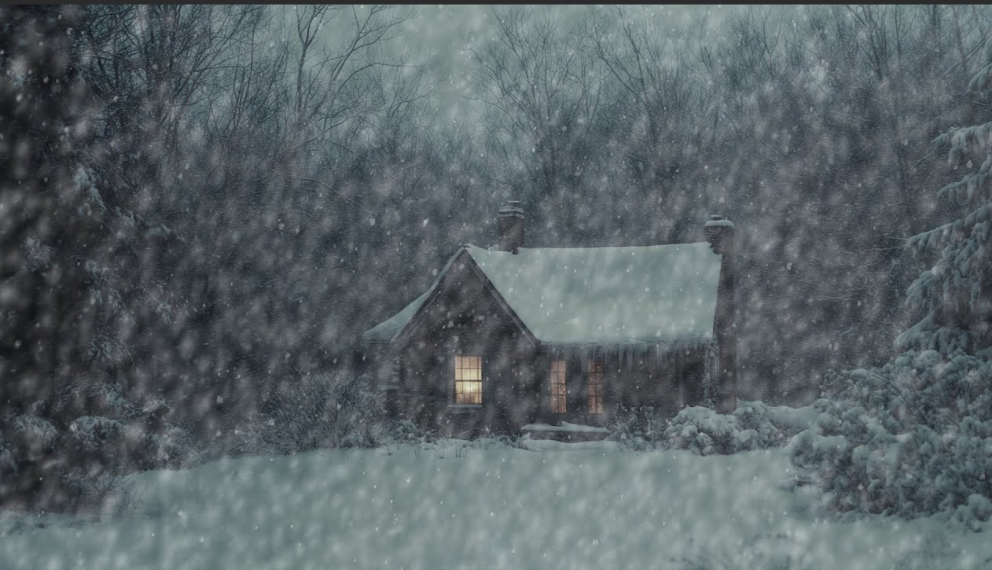
The Snow-Storm

By Ralph Waldo Emerson

Announced by all the trumpets of the sky,

Arrives the snow, and, driving o’er the fields,

Seems nowhere to alight: the whited air

Hides hills and woods, the river, and the heaven,

And veils the farm-house at the garden’s end.

The sled and traveller stopped, the courier’s feet

Delayed, all friends shut out, the housemates sit

Around the radiant fireplace, enclosed

In a tumultuous privacy of storm.

Come see the north wind’s masonry.

Out of an unseen quarry evermore

Furnished with tile, the fierce artificer

Curves his white bastions with projected roof

Round every windward stake, or tree, or door.

Speeding, the myriad-handed, his wild work

So fanciful, so savage, nought cares he

For number or proportion. Mockingly,

On coop or kennel he hangs Parian wreaths;

A swan-like form invests the hidden thorn;

Fills up the farmer’s lane from wall to wall,

Maugre the farmer’s sighs; and, at the gate,

A tapering turret overtops the work.

And when his hours are numbered, and the world

Is all his own, retiring, as he were not,

Leaves, when the sun appears, astonished Art

To mimic in slow structures, stone by stone,

Built in an age, the mad wind’s night-work,

The frolic architecture of the snow.

The Human Atmosphere as a Global Sparksphere

How Brains Broadcast Coherence Across the Planet

Recent findings from Princeton University suggest something quietly astonishing:

Human brains emit ultra-low-frequency (ULF) electromagnetic waves that may form a planetary neural network. These faint signals, slower than typical brainwaves, can travel through the Earth’s crust and atmosphere, potentially influencing other brains up to 10,000 kilometers away.

No wires. No internet. Just the quiet hum of biology interacting with the physics of the planet.

This discovery reframes our understanding of consciousness, not as isolated cognition, but as field-based participation.

Neural Fission: A New Kind of Contribution

In Fractal Universe, every Sparksphere radiates energy through Fission: the release of contribution into the surrounding terrain. A word spoken, a gesture made, a decision taken—all are forms of directional Fission.

But ULF brain waves suggest something subtler: Ambient Fission, a continuous, non-verbal broadcast of orientation and coherence.

This isn’t just one Sparksphere acting. It’s many Sparkspheres synchronizing, forming a distributed Mirror Frontier across the globe. The Human Atmosphere becomes a global Sparksphere, pulsing with nested awareness.

Stillpoint Alignment vs. Field Resonance

Previously, Fractal Universe described individuals aligning with the Stillpoint of the Human Atmosphere, a vertical tuning into inherited geometry. But this new insight reveals a horizontal resonance:

  • Stillpoint alignment is intentional: a conscious act of orientation.
  • Neural field resonance is ambient: a passive, ongoing contribution.

Together, they form a recursive feedback loop: the more individuals align, the more coherent the field becomes; the more coherent the field, the easier it is for individuals to align.

This is not just nested; it’s symbiotic.

Consciousness as Terrain

The Human Atmosphere is not bounded by skin or skull. It is porous, radiant, and recursive. Your thoughts, emotions, and intentions ripple outward, not just through language, but through electromagnetic coherence.

You are not just thinking. You are broadcasting.

You are not just receiving. You are resonating.

The Human Atmosphere is not a metaphor. It is a living field of nested Sparkspheres, each contributing to the whole.