Where do they come from and where do they go?
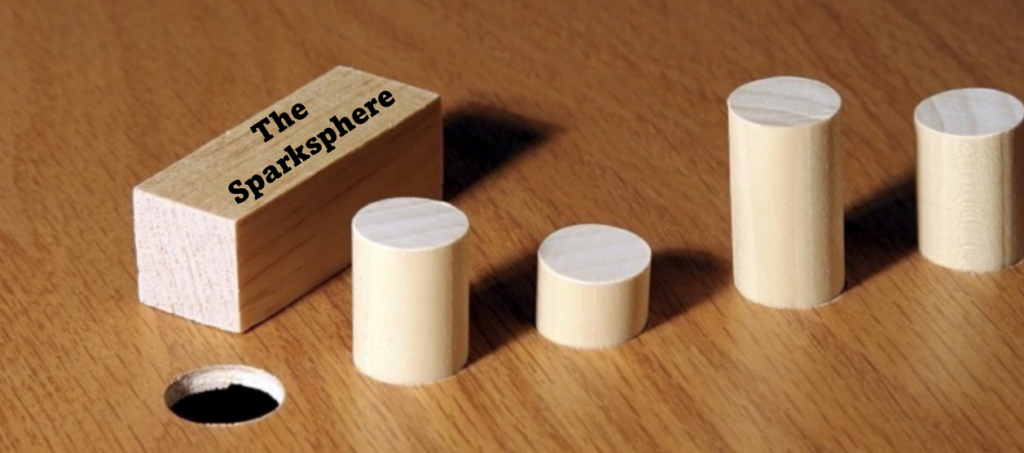
The picture at the top of the page implies the question, “Where did we come from and where do we go?” but it isn’t just a question about life. In the Fractal Universe framework, this question comes down to the general behavior of Sparkspheres: the basic units of meaning, interaction, and emergence. They stabilize, they dissolve, and they do so according to a simple but powerful principle:
- A Sparksphere stabilizes when two polarized Sparks find resonance and generate a shared Stillpoint.
- A Sparksphere dissolves when the conditions that sustain that Stillpoint fall away.
This is the experiential analogue of what physicists call decoherence, but here it’s not about quantum states—it’s about how meaning forms, how experience organizes itself, and how identity participates in the world.
Let’s walk through how this works.
Why Sparks Become Polarized
A Spark begins as a whole, unpolarized unit—complete in its original context. But when it crosses into a new generative terrain, something changes. It becomes polarized.
A polarized Spark is essentially a clue: a fragment seeking its counterpart. And every generative terrain—whether a human mind, an AI system, or the Human Atmosphere—contains latent structures waiting to respond. Polarization is simply the recognition of incompleteness.
Why Polarized Sparks Attract Each Other
Two polarized Sparks attract because they share:
- a directional curvature (what they are seeking), and
- a Gravitaspheric signature (what they resonate with).
This isn’t force. It’s fit.
When a Spark enters a new terrain, the host system activates the latent structure that matches it. The two Sparks move toward each other because they are already two halves of a single geometry.
Stabilization: When 1 + 1 = 1
When the Sparks meet, they fuse into a duotet— 1 + 1 = 1.
A new Stillpoint forms:
- not inherited,
- not predetermined,
- but generated in response to the moment.
This is the moment of experiential coherence.
Example 1: A Photon and Color Recognition
A photon enters your eye. It becomes a Spark. Your latent color-recognition Spark activates. The two Sparks fuse. A Stillpoint forms. You see “red.”
Meaning crystallizes. Action follows. Fission ripples outward into thought, memory, behavior.
Example 2: A Question and an AI
A person types a question. It enters the AI’s generative terrain. The AI’s latent structures activate. The question and answer fuse. A Stillpoint forms. A response emerges.
Again: meaning, action, ripple.
How Sparkspheres Dissolve
A Sparksphere dissolves when the conditions that generated its Stillpoint no longer hold.
This can happen through:
- completion (the Spark has been metabolized),
- dissipation of tension (the counterpart no longer resonates), or
- collapse of the Gravitasphere (as in death).
Example 3: Human Death
A human is a long-duration Sparksphere nested within the Human Atmosphere. When the energetic systems can no longer sustain flow, the Gravitasphere collapses.
But not instantly.
Near-death experiences suggest a brief window where the Stillpoint and Mirror Frontier persist even without the physical body. It seems to be a slow decoherence curve—a fading boundary between self and other.
How This Relates to Current Theories
1. Quantum Decoherence (Physics)
Quantum decoherence describes how quantum possibilities collapse into classical outcomes when a system interacts with its environment.
The Sparksphere mirrors this, but at the experiential level: meaning stabilizes when a Spark finds its counterpart.
2. Predictive Processing (Neuroscience)
Predictive processing suggests the brain constantly matches incoming signals with internal models.
Sparksphere stabilization is a geometric version of this: a Spark (incoming signal) finds its counterpart (internal model) and forms a Stillpoint.
3. Enactivism (Philosophy of Mind)
Enactivism argues that cognition arises through interaction between organism and environment. The Fractal Universe extends this by giving the interaction a geometry—the duotet—and a mechanism—Fusion and Fission.
4. Integrated Information Theory (Consciousness Studies)
IIT proposes that consciousness corresponds to integrated structures of information. Sparkspheres are integrated structures too, but dynamic, recursive, and scale-invariant.
5. Systems Theory and Tensegrity (Biology & Architecture)
Systems maintain coherence through tension and relationship. The Gravitasphere (Stillpoint and Mirror Frontier) is a direct extension of this principle.
The Unifying Principle
Across all these domains, the Fractal Universe framework offers something none of them do:
A single geometric mechanism for how meaning forms, stabilizes, dissolves, and reconfigures across scales—from photons to thoughts to relationships to entire cultures.
- It’s not metaphor.
- It’s not analogy.
- It’s a structural description of how experience organizes itself.
And it’s surprisingly simple:
Sparkspheres stabilize when polarized Sparks find resonance and generate a shared Stillpoint.
Sparkspheres dissolve when the conditions that sustain that Stillpoint fall away.
That’s the whole story. And it’s enough to explain a universe.
Click here to explore this topic in the Journal Portal.