The big things we would like to accomplish can sometimes seem out of reach. We might have a good idea of how to proceed, but we struggle to make it happen. Over time, this can lead to a feeling of overwhelm. Today let’s take a look at a way I’ve made overwhelm evaporate from my inner world, Jungle Island.
There are days on Jungle Island when the air feels thick. Not because of weather, but because of too many sparks. Questions looking for answers. Problems looking for solutions. Needs looking for resources. All of them circling, calling, tugging.
When this goes on long enough, the sparks change shape. They become Meemies — insistent, frustrated little monsters, pacing at the edges of the clearing.

They want to be heard, and that is the first step. Just listen. Meemies don’t want perfection. They want relief.
And this is where my inner resource of strategy, Cap, steps forward. Cap doesn’t chase complexity. He doesn’t negotiate with overwhelm. He doesn’t try to solve everything at once.
He practices Serious Planning — the kind that is honest about limits and loyal to follow‑through.
Serious Planning is not glamorous. It’s not heroic. It’s not even big. It’s simple. It’s the inner version of the old KISS principle:
Keep It Simple, Stupid — though Cap would never call anyone stupid. He would say: Keep it simple because simplicity is strong. Keep it simple because complexity is a trap. Keep it simple because you deserve a path you can actually walk.
A KISS plan is small on purpose. One task. One direction. One step that can be completed today. Because on Jungle Island, motion matters more than magnitude. A tiny action taken in the right direction is worth more than a brilliant plan that never leaves the page.
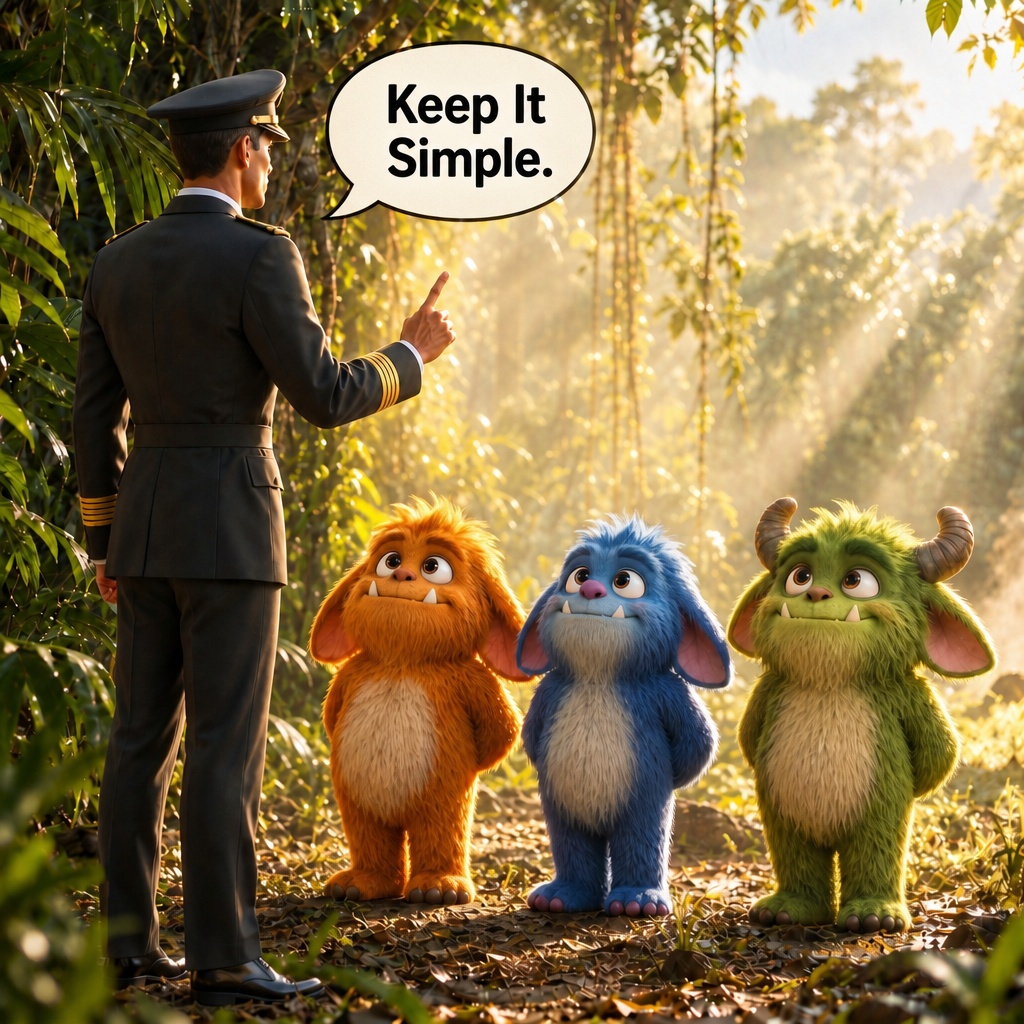
And something beautiful happens when you take that small step: The Meemies quiet down. Not because everything is solved, but because they feel heard. They feel you moving toward them instead of away.
This is the same wisdom the lighthouse keeper lives by. Her job is simple, repetitive, essential. She doesn’t try to illuminate the whole island — only the shoreline she’s responsible for. And because she keeps it simple, the whole island becomes safer.
Overwhelm is what happens when the island fills with too many signals at once. Simplicity is what happens when you choose one signal and follow it.
- So if today feels heavy, crowded, or tangled, try this:
- Pick one Meemie.
- Listen to what it’s asking for.
- Make a KISS plan — the smallest helpful action you can take.
- Do it.
- Let that be enough.
On Jungle Island, simplicity isn’t a shortcut. It’s a form of care. A way of saying to yourself: I don’t have to solve everything. I only have to take the next true step.
If you would like to explore KISS and Serious Planning in the Journal Portal, click here.