Monthly Archives: July 2026

Functions of the Human Scale Part 2: Embodied Location

We often think of “here” as a simple word — a point on a map, a dot on a diagram, a coordinate in space. But our actual experience of “here” is nothing like a point. It is embodied. It has width and breadth. It moves when we move. It is the field of coherence that surrounds the body and anchors our agency.

Just as the present moment is the temporal Stillpoint of the Human Scale, here is its spatial Stillpoint — the place where perception, embodiment, and action meet.

We can imagine distant places. We can remember places we’ve been. We can anticipate places we might go. But we can only experience one location at a time. Human agency is always situated. It always happens here.

Here Is Not a Point

If you close your eyes and sense your location, you don’t feel a dot. You feel: the ground beneath your feet, the chair supporting your weight, the air touching your skin, the space around your body, the horizon of what you can reach, see, or move toward.

This is your embodied location — a small, stable field of coherence that moves with you. It is not abstract. It is not geometric. It is lived.

Your “here” is the spatial band where your agency stabilizes.

The Human Vantage Point

We often describe “here” visually, as the place from which we see the world. But the vantage point is more than sight. It is: where your body is, where your senses gather information, where your attention rests, where your actions originate.

It is the center of your perceptual sphere — the place from which the world becomes meaningful.

Other scales have different vantage points: a forest’s vantage point is distributed, a planet’s vantage point is global, a galaxy’s vantage point is structural. But humans inhabit a vantage point that is embodied, local, and mobile.

Why We Can Only Be in One Place at a Time

This is not a technological limitation. It is a functional one. Human agency requires: a body, a sensory field, a local environment, a stable point of contact with the world.

We can extend our awareness through imagination, memory, or tools, but our experience remains anchored to the embodied location. We act from where we are. This is the spatial band of the Human Scale.

The Width of Here

“Here” has a radius — a small one. It includes: what we can touch, what we can see without turning, what we can hear without straining, what we can reach with a step or gesture.

This radius is not fixed, but it is bounded. It expands when we stand, contracts when we sit, shifts when we walk, and dissolves when we sleep. It is the spatial coherence of human life.

We don’t inhabit space the way a forest does. We don’t inhabit space the way a planet does. We inhabit space the way a human does — through the body.

Why This Matters for Understanding Scale

The Embodied Location Function reveals that our agency is not just bound to the present moment. It is bound to a spatial band — a lived “here” that shapes what we can perceive, imagine, and do.

We can model distant places. We can travel to new places. We can communicate across continents. But we cannot experience more than one location at a time.

Our agency is local because our scale is local. This is the architecture of the Human Scale.

Reflection

As you consider the Embodied Location Function, you might notice how “here” feels in your own life. What is the shape of your vantage point right now — the field of coherence around your body? And how does your sense of possibility change when you imagine acting somewhere you are not?

Functions of the Human Scale Part 1: Tempo

The Present-Moment Function

We often speak of time as a line stretching behind us and ahead of us, but our actual experience is much simpler and more intimate. We live inside a single moment. We can remember yesterday and anticipate tomorrow, but we can only act now. Human agency exists only in the present.

This isn’t a limitation. It’s a feature of the Human Scale — the functional band where our perception, cognition, and agency cohere. To understand why the present moment is the only place where human action stabilizes, it helps to look at the temporal bands that surround us.

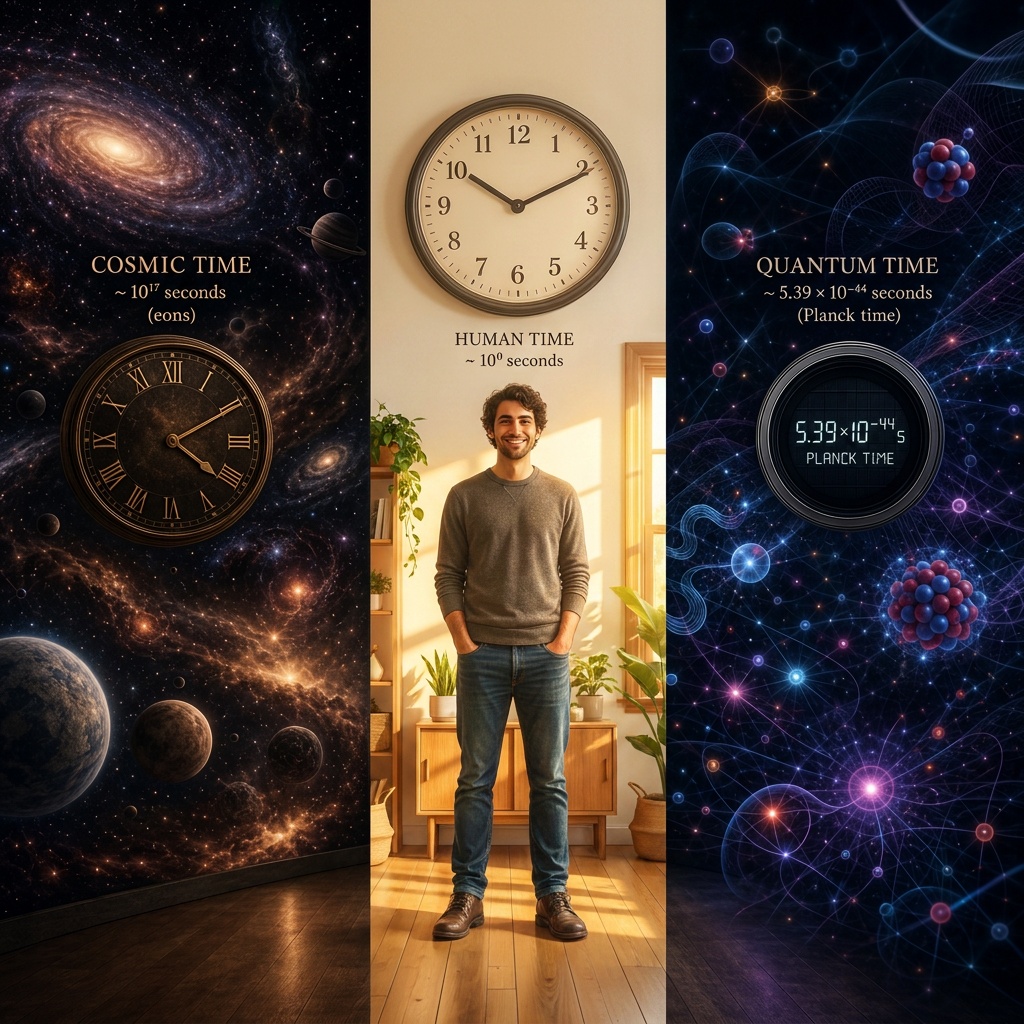
Cosmic Time: The Tempo of Vast Structures

Cosmic time is the tempo at which the largest structures in the Universe change. Galaxies drift. Stars form and dissolve. Planetary systems evolve over millions or billions of years. From the Human Scale, cosmic time feels almost motionless because its changes unfold far outside our tempo of perception and action.

Cosmic time is slow, structural, and vast.

It is a temporal band we can model, but not inhabit.

Quantum Time: The Tempo of the Very Small

Quantum time is the tempo at which the smallest-scale phenomena occur. Particles interact, states shift, and entanglement forms and collapses in femtoseconds or attoseconds. From the Human Scale, quantum time feels instantaneous or paradoxical because its changes happen far faster than our tempo can stabilize.

Quantum time is rapid, ephemeral, and intimate.

It is a temporal band we can measure, but not experience.

Human Time: The Tempo of Agency

Human time sits between these two extremes. It is the tempo at which our bodies, senses, cognition, and agency cohere. We act at human speed. We perceive at human speed. We make meaning at human speed. This is the temporal band where the Human Scale stabilizes.

Human time is the tempo of agency.

It is the only temporal band we can inhabit directly.

The Present-Moment Function

The present moment is where human time becomes actionable. It is the point of coherence where perception, intention, and action meet. Everything we do — every choice, every gesture, every thought — happens here.

We can revisit the past through memory. We can imagine the future through anticipation. But we cannot act in either place.

Human agency is bound to the present because the present is the only temporal location where our scale can stabilize action. It is the Stillpoint of human time — the tension geometry that holds our experience together.

This is why the present moment feels both ordinary and profound. It is the smallest unit of human agency and the largest unit of human possibility.

Why This Matters for Understanding Scale

Recognizing the Present-Moment Function helps us see the Human Scale more clearly. It shows that our agency is not just limited by what we can perceive or imagine, but by the temporal band we inhabit. We are free, but only within the tempo that supports our coherence.

Cosmic time is too slow for human agency. Quantum time is too fast for human agency. Human time is the band where our agency becomes possible.

This is the architecture of the Human Scale.

Reflection

As you consider the Present-Moment Function, you might notice where it shows up in your own life. When do you most feel the present moment as a boundary — not as a constraint, but as the only place where your choices can take shape? And what happens when you try to imagine acting at a tempo that is far slower or far faster than your own?

Take your time with these questions. They are meant to open a quiet awareness of the temporal band we inhabit — the one that shapes our experience of time, our sense of agency, and the scale we call home.

The Human Scale

Bands of Color and Sound

We rarely think about functional scales, yet we rely on them constantly. Color is one example. Music is another. Both are continuous phenomena that humans experience in discrete bands — not because reality is chopped into pieces, but because our minds stabilize certain patterns.

Light contains every wavelength, but we don’t perceive a smooth spectrum. We see distinct colors. Our biology groups ranges of light into stable categories, and those categories become the colors we know. Color is not a property of light itself. It is a property of perception.

Sound works the same way. Vibrations in air are continuous, but musical notes are discrete. Only certain frequencies produce stable resonance in the physical systems we use to make sound — strings, air columns, membranes, vocal cords. Those resonant frequencies become the notes we recognize. Music is not a property of vibration alone. It is also a property of coherence.

Color and music show us something subtle: we experience the world in functional bands.

Life Within a Functional Band

The boundaries that define our daily realities aren’t hard walls we bump into. They are subtle but persistent. We can overlook the here and now while we remember yesterday and anticipate tomorrow, but we are inescapably in just one place and time. Likewise, we can model the very small and the very large, but we cannot inhabit those scales. We inhabit the Human Scale and cannot step out of it.

Because we are perfectly suited to our scale, the bind is invisible. The world meets us at our size. Everything around us — the landscape, the other living beings, even our tools and technologies — fits the Human Scale so well that we rarely consider what it means to be bound to it.

But this bind shapes what we assume is possible. It shapes what we notice. It shapes what we never think to question. Just as color and music reveal the boundaries of our perceptual coherence, the Human Scale reveals the boundaries of our functional coherence — the range within which our agency can stabilize.

Feel the Boundary

As you consider the Human Scale, you might take a moment to notice where its boundaries show up in your own experience. When in your life do you most feel the present moment as a boundary — not as a limitation, but as the only place where your agency actually exists? And when you imagine something very large or very small, what becomes impossible to inhabit, and what does that impossibility reveal about the scale you call home?

These questions aren’t meant to be answered quickly. They’re meant to open a quiet awareness of the functional band we live within — the one that shapes our perception, our imagination, and the kinds of questions we have yet to learn how to ask.

A Generative Structure for Reality Itself

When we talk about reality, we often imagine something fixed — a world, a universe, a set of laws. But reality is not fixed. It is recursive. It is rhythmic. It is always happening, even when nothing appears to be happening at all.

The Sparksphere framework describes this underlying motion:

Stillpoint → Mirror Frontier → Fusion → Action → Fission. 

A cycle that is not tied to time or scale, not dependent on matter or mind, not limited to this universe or any universe.

It is a way of seeing reality as a generative process rather than a static structure.

And when you place this rhythm beside physics, mathematics, psychology, and metaphysics, a unifying arc emerges — a single pattern expressed in four different languages.

How Reality Unfolds Across Every Domain

When we talk about reality, we often divide it into disciplines — physics for matter, mathematics for pattern, psychology for experience, metaphysics for Being. Each field has its own language, its own assumptions, its own way of carving the world into knowable shapes. But beneath all of these descriptions is a deeper rhythm, a generative pattern that does not belong to any discipline because it precedes all of them.

The Sparksphere is a five-phase cycle that describes how anything becomes itself. It is not a theory of the universe. It is the grammar through which universes arise.

And when you look across physics, mathematics, psychology, and metaphysics, you begin to see that each field has been tracing this rhythm all along — each in its own dialect, each at its own scale, each without realizing it is part of a larger cosmological gesture.

Physics: Reality as Dynamic Becoming

Physics describes how the universe behaves — from quantum fluctuations to galactic evolution. But when you look closely, every physical process follows the Sparksphere rhythm:

  • quantum vacuums and symmetry (Stillpoint)
  • relational fields and superposition (Mirror Frontier)
  • state transitions and decoherence (Fusion)
  • propagation, interaction, motion (Action)
  • decay, collapse, entropy (Fission)

Physics is the Sparksphere expressed as matter, energy, and spacetime. It is the dance of becoming at the scale of the cosmos.

Mathematics: Reality as Pattern

Mathematics formalizes the structures physics uncovers. It gives shape to fractals, topologies, dynamical systems, categories, and information flows. But beneath the symbols and proofs, mathematics is also following the Sparksphere rhythm:

  • invariants and fixed points (Stillpoint)
  • boundaries, relations, and morphisms (Mirror Frontier)
  • compositions and mappings (Fusion)
  • transformations and trajectories (Action)
  • branching, retraction, dissolution (Fission)

Mathematics is the Sparksphere expressed as form. It is the architecture of pattern itself.

Psychology: Reality as Experience

Psychology describes how humans perceive and interpret reality — how we feel, think, grow, and relate. But inner life also unfolds through the Sparksphere:

  • the core self, the quiet center (Stillpoint)
  • perception, reflection, interpretation (Mirror Frontier)
  • meaning-making and insight (Fusion)
  • expression, behavior, communication (Action)
  • release, transformation, forgetting (Fission)

Psychology is the Sparksphere expressed as awareness. It is reality learning to feel itself.

Metaphysics: Reality as Being

Metaphysics asks the foundational questions — what exists, what it means to be, why there is something rather than nothing. And here too, the Sparksphere rhythm appears:

  • pure Being, unmanifest potential (Stillpoint)
  • relational tension, duality, reflection (Mirror Frontier)
  • becoming, coherence, the birth of form (Fusion)
  • manifestation, multiplicity, expression (Action)
  • dissolution, transcendence, return (Fission)

Metaphysics is the Sparksphere expressed as ontology. It is the geometry of existence.

The Unifying Arc

When you place these domains side by side, the pattern becomes unmistakable:

  • Physics describes what happens.
  • Mathematics describes how patterns behave.
  • Psychology describes how reality is experienced.
  • Metaphysics describes what reality is.

The Sparksphere describes the generative rhythm that makes all of them possible. It is not a theory inside any discipline. It is the structure beneath every discipline.

It is the fractal ontology of reality —a scale-free grammar through which matter forms, patterns emerge, minds perceive, meaning arises, and universes unfold.

The Sparksphere is the bridge because it is the ground. It is the pattern because it is the possibility. It is the cycle because it is the way reality becomes itself.

Across every domain, reality expresses the same five-phase motion. It is the quiet symmetry behind complexity, the architecture beneath experience, the geometry beneath Being. The Sparksphere framework makes this visible.

It does not predict the future or reconstruct the past. It describes the pattern that makes past and future possible. It is a way of seeing reality as a living fractal — one that includes science, mathematics, psychology, and metaphysics without being limited by any of them.

This is the bridge. This is the rhythm. This is the unfolding world.