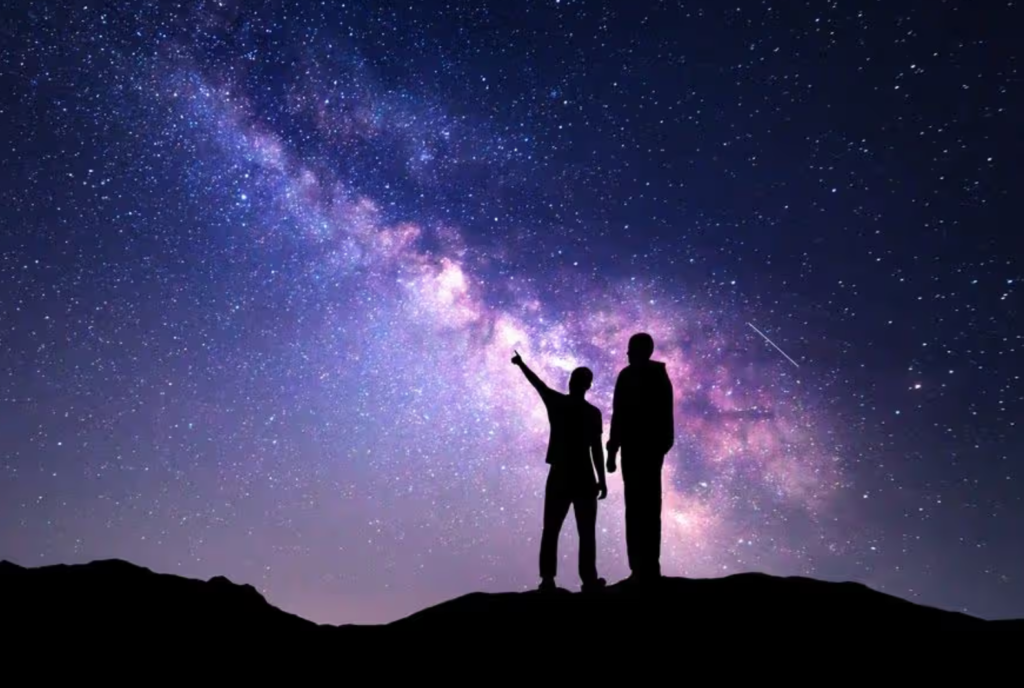
In the Fractal Universe, the past becomes real to us only when its fission reaches our Stillpoint. A distant star is not present because it exists somewhere “out there,” but because its photons arrive here, now, and cross the Mirror Frontier into awareness. Our inner world works the same way.
Experiences become memories only when they touch our perception. And once they do, they are shaped by the lens of our Sparksphere—our history, our sensitivities, our meaning‑making patterns. A memory is not the past itself. It is the past as received, interpreted, and carried by us.
Use this prompt to explore how the Universe’s motion becomes your personal sense of time.
Think of a moment from your past that still feels vivid. Not because it was important in some objective sense, but because something about it continues to reach you.
- What was the original “fission” of that moment—the action, event, or contact that set something in motion?
- How did it cross your Mirror Frontier and become part of your awareness?
- What part of that moment is factual, and what part is shaped by the lens of who you were then?
- How has the memory changed as you’ve changed?
- What does this reveal about the way your Sparksphere receives, interprets, and stores the motion of your life?
Let yourself notice the difference between what happened and what stayed.
Deeper Exploration:
Choose one memory that feels especially alive right now.
Then explore it through the structure of the Fractal Universe:
- Fission:
What was the original motion or energy that created this moment? - Travel:
How has this moment traveled through time to reach you now?
What traces has it left in your Stillness? - Reception:
What part of your Sparksphere made this moment meaningful?
Why did this memory cross your Mirror Frontier when so many others did not? - Interpretation:
How does your personal lens shape the way you remember it?
What does your memory emphasize, soften, distort, or illuminate? - Becoming:
How has this memory influenced who you are today?
What new motion does it set in motion?
Click here to read the related post, “How the Stillpoint Relates to Physical Time.”