The Present-Moment Function
We often speak of time as a line stretching behind us and ahead of us, but our actual experience is much simpler and more intimate. We live inside a single moment. We can remember yesterday and anticipate tomorrow, but we can only act now. Human agency exists only in the present.
This isn’t a limitation. It’s a feature of the Human Scale — the functional band where our perception, cognition, and agency cohere. To understand why the present moment is the only place where human action stabilizes, it helps to look at the temporal bands that surround us.
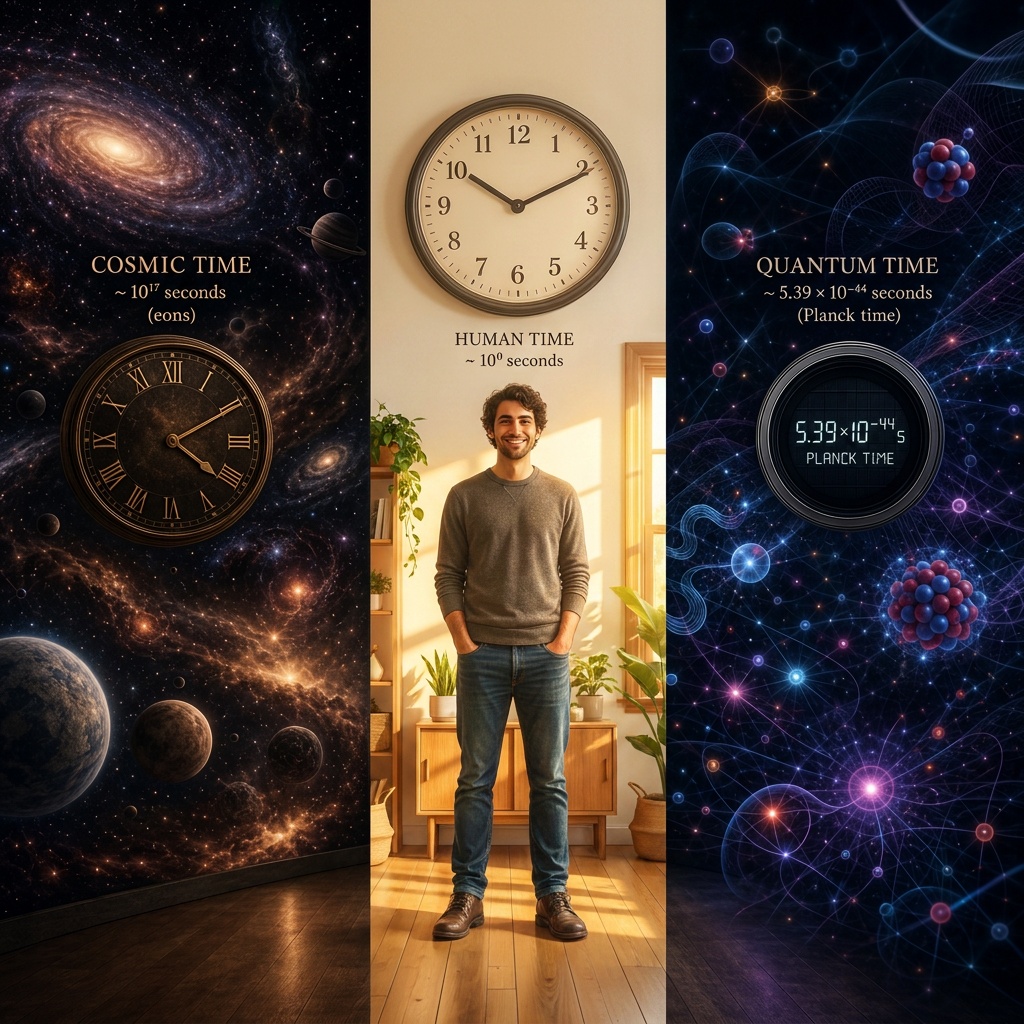
Cosmic Time: The Tempo of Vast Structures
Cosmic time is the tempo at which the largest structures in the Universe change. Galaxies drift. Stars form and dissolve. Planetary systems evolve over millions or billions of years. From the Human Scale, cosmic time feels almost motionless because its changes unfold far outside our tempo of perception and action.
Cosmic time is slow, structural, and vast.
It is a temporal band we can model, but not inhabit.
Quantum Time: The Tempo of the Very Small
Quantum time is the tempo at which the smallest-scale phenomena occur. Particles interact, states shift, and entanglement forms and collapses in femtoseconds or attoseconds. From the Human Scale, quantum time feels instantaneous or paradoxical because its changes happen far faster than our tempo can stabilize.
Quantum time is rapid, ephemeral, and intimate.
It is a temporal band we can measure, but not experience.
Human Time: The Tempo of Agency
Human time sits between these two extremes. It is the tempo at which our bodies, senses, cognition, and agency cohere. We act at human speed. We perceive at human speed. We make meaning at human speed. This is the temporal band where the Human Scale stabilizes.
Human time is the tempo of agency.
It is the only temporal band we can inhabit directly.
The Present-Moment Function
The present moment is where human time becomes actionable. It is the point of coherence where perception, intention, and action meet. Everything we do — every choice, every gesture, every thought — happens here.
We can revisit the past through memory. We can imagine the future through anticipation. But we cannot act in either place.
Human agency is bound to the present because the present is the only temporal location where our scale can stabilize action. It is the Stillpoint of human time — the tension geometry that holds our experience together.
This is why the present moment feels both ordinary and profound. It is the smallest unit of human agency and the largest unit of human possibility.
Why This Matters for Understanding Scale
Recognizing the Present-Moment Function helps us see the Human Scale more clearly. It shows that our agency is not just limited by what we can perceive or imagine, but by the temporal band we inhabit. We are free, but only within the tempo that supports our coherence.
Cosmic time is too slow for human agency. Quantum time is too fast for human agency. Human time is the band where our agency becomes possible.
This is the architecture of the Human Scale.
Reflection
As you consider the Present-Moment Function, you might notice where it shows up in your own life. When do you most feel the present moment as a boundary — not as a constraint, but as the only place where your choices can take shape? And what happens when you try to imagine acting at a tempo that is far slower or far faster than your own?
Take your time with these questions. They are meant to open a quiet awareness of the temporal band we inhabit — the one that shapes our experience of time, our sense of agency, and the scale we call home.