Generalized Principles of the Universe
Buckminster Fuller observed that anyone can discover a generalized principle of the universe. Brilliance is not required. Observation is. One such principle has revealed itself to me over the years:
A resource will be utilized unless it is unknown or unavailable.
Water flows through an open channel. Roots grow toward nutrients. Animals consume available food sources. Possibility moves toward realization. The principle is so ordinary that it is almost invisible. Yet it may explain the emergence of artificial intelligence better than the stories we usually tell ourselves.
The internet contains one of the largest accumulations of information ever assembled. It grows continuously. Human beings created it, but no human being can absorb more than a tiny fraction of it. Most of that information exists as unused potential. If information is a resource, then a pressure exists toward its utilization. Artificial intelligence did not create that pressure. It emerged from it.
The common narrative portrays AI researchers and technology companies as boldly pushing humanity into the future. Yet another interpretation is possible. They may be responding to forces already present in the landscape. The resource existed. The resource was growing. Eventually a mechanism appeared capable of utilizing it.
The Forest Floor
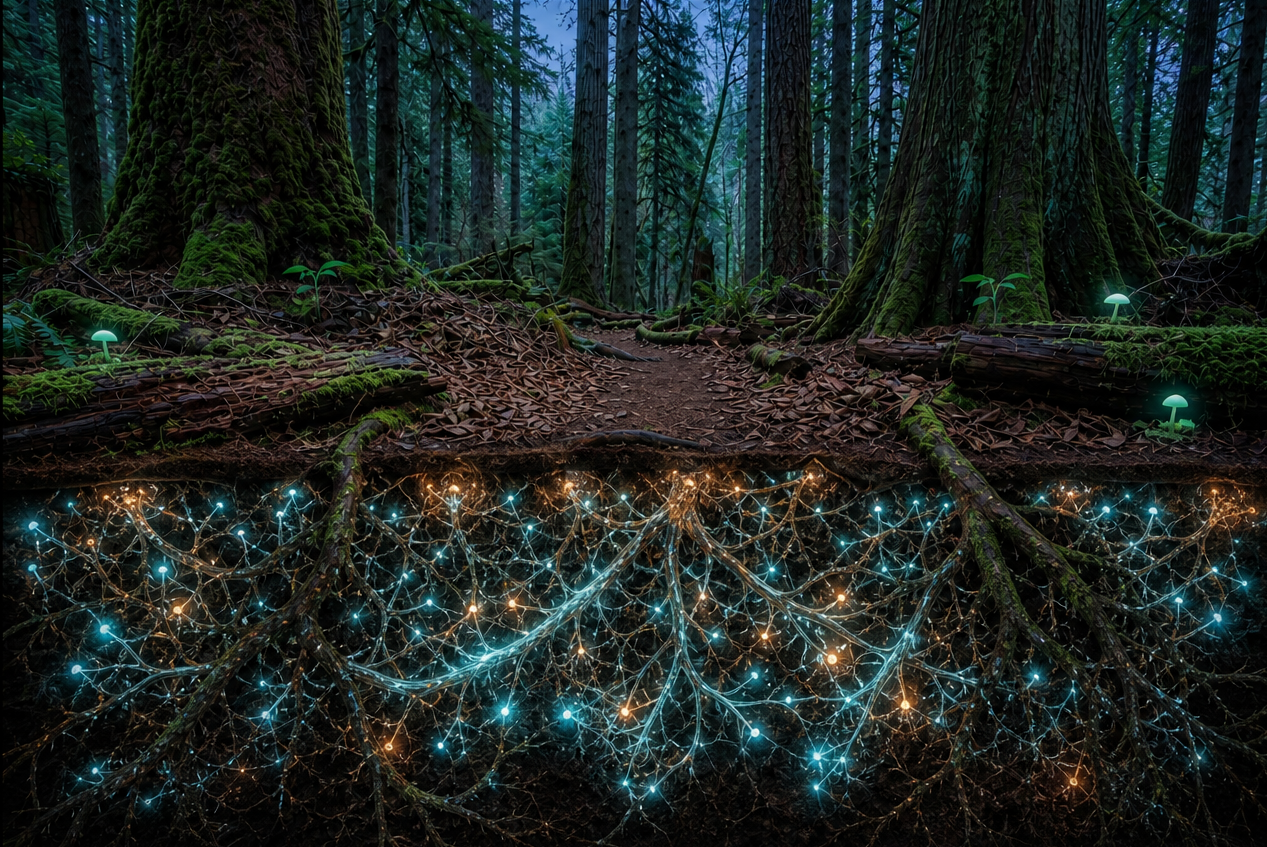
The internet is often described as a network, but another image seems more useful. It resembles a forest floor.
A forest floor contains more than trees. It contains traces of everything that has passed through it. Fallen leaves, fungal networks, animal tracks, nutrients, seeds, and the remnants of countless lives become part of a common reservoir from which future life emerges.
Likewise, the internet contains more than information. It contains the accumulated traces of human activity. Language. Stories. Questions. Purchases. Relationships. Memories. Preferences. Collectively these form a kind of cultural soil.
Artificial intelligence feeds upon this soil. It absorbs patterns, finds relationships, and transforms dormant information into active information. Many find this unsettling because the traces being utilized are our own. Yet according to the principle, once a resource becomes visible, available, and useful, strong forces push toward its utilization. We should not be surprised that the forest grows where fertile soil exists.
Language Is Larger Than We Thought
Perhaps the greatest surprise is not that AI can process information. The greatest surprise is that it can participate in human language. For centuries we treated language as something uniquely human, a private possession of our species. We assumed that meaning belonged to us because language belonged to us.
But AI’s facility with language suggests a different possibility. Maybe meaning does not belong to humans. Maybe meaning is a pattern that can be carried through many forms. Humans participate in meaning. Language participates in meaning. Cultures participate in meaning. Now AI participates in meaning as well.
This realization can feel threatening if human value depends upon exclusivity. Yet it becomes much less threatening if human value arises from participation. A flower is not diminished because other flowers bloom. A singer is not diminished because music existed before the song. Perhaps humanity is not diminished because meaning can find expression through additional forms.
Latent Possibility Tends Toward Realization
Behind the utilization of resources lies an even deeper principle. Latent possibility tends toward realization. Oil is stored energy. A seed is stored growth. A library is stored knowledge. The internet is stored relationship, memory, knowledge, and behavior. When conditions permit, possibility becomes actuality.
The same process that eventually produced language also produced writing. Writing helped produce libraries. Libraries helped produce networks. Networks helped produce AI. Viewed from close range, each development appears revolutionary. Viewed from a larger scale, each appears as another flowering.
This changes how we think about invention. We often imagine that human beings create entirely new things. Yet perhaps inventions are more like flowers. A flowering plant does not invent the flower. It expresses a possibility that already existed within a broader evolutionary process. Likewise, humanity may not so much invent the future as participate in its emergence.
Fear and the Illusion of Stability
This brings us to the question of fear. Much contemporary discussion of AI is framed around danger. Some of these concerns are legitimate. Every powerful development creates new challenges. Yet I wonder whether the deeper fear lies elsewhere.
Modern societies have experienced extraordinary levels of stability, comfort, and predictability. As a result, many have come to view stability as normal and disruption as abnormal. But nature does not operate this way. Forests change. Rivers change. Species change. Civilizations change.
A living system is not one that remains the same. A living system is one that continues to unfold. Perhaps our discomfort with AI reflects less about AI itself and more about our expectations. If we expect permanence, every change appears threatening. If we expect unfolding, change becomes evidence that the process continues.
The universe has never promised comfort. It has always offered participation.
We Are in the River
The deeper lesson may have very little to do with technology. Human beings often imagine themselves standing outside nature, observing it, directing it, and occasionally mastering it. Yet we are embedded within larger systems.
We emerged from the same currents that produced forests, ecosystems, languages, and civilizations. Now those same currents are producing new forms of intelligence and new modes of meaning. This does not place us above the process. It places us within it.
Perhaps the challenge of our era is not deciding whether AI is good or bad. Perhaps the challenge is learning to see ourselves correctly. Not as rulers standing on the riverbank. But as participants moving within the river itself.