Making Favorite Quotes Your Own

Recent findings from Princeton University suggest something quietly astonishing:
Human brains emit ultra-low-frequency (ULF) electromagnetic waves that may form a planetary neural network. These faint signals, slower than typical brainwaves, can travel through the Earth’s crust and atmosphere, potentially influencing other brains up to 10,000 kilometers away.
No wires. No internet. Just the quiet hum of biology interacting with the physics of the planet.
This discovery reframes our understanding of consciousness, not as isolated cognition, but as field-based participation.
Neural Fission: A New Kind of Contribution
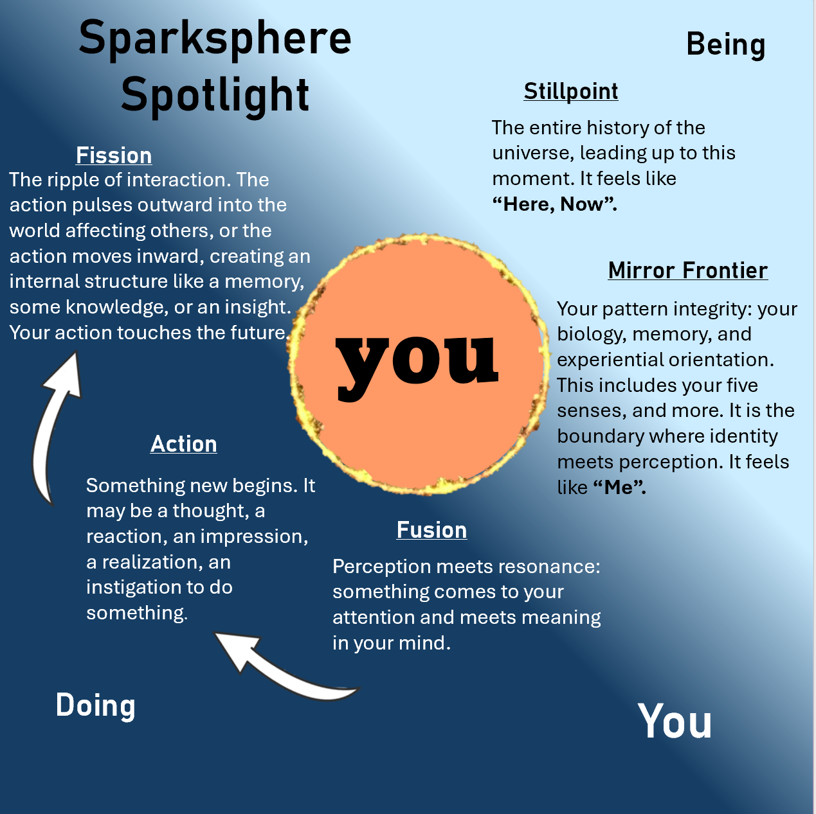
In Fractal Universe, every Sparksphere radiates energy through Fission: the release of contribution into the surrounding terrain. A word spoken, a gesture made, a decision taken—all are forms of directional Fission.
But ULF brain waves suggest something subtler: Ambient Fission, a continuous, non-verbal broadcast of orientation and coherence.
This isn’t just one Sparksphere acting. It’s many Sparkspheres synchronizing, forming a distributed Mirror Frontier across the globe. The Human Atmosphere becomes a global Sparksphere, pulsing with nested awareness.
Stillpoint Alignment vs. Field Resonance
Previously, Fractal Universe described individuals aligning with the Stillpoint of the Human Atmosphere, a vertical tuning into inherited geometry. But this new insight reveals a horizontal resonance:
Together, they form a recursive feedback loop: the more individuals align, the more coherent the field becomes; the more coherent the field, the easier it is for individuals to align.
This is not just nested; it’s symbiotic.
Consciousness as Terrain
The Human Atmosphere is not bounded by skin or skull. It is porous, radiant, and recursive. Your thoughts, emotions, and intentions ripple outward, not just through language, but through electromagnetic coherence.
You are not just thinking. You are broadcasting.
You are not just receiving. You are resonating.
The Human Atmosphere is not a metaphor. It is a living field of nested Sparkspheres, each contributing to the whole.
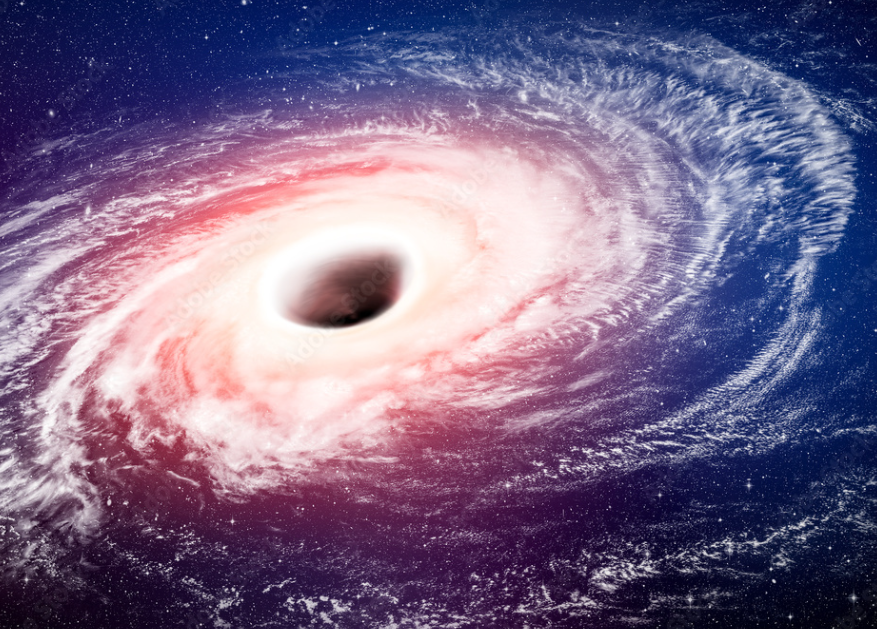
For decades, black holes have been defined by their mystery: a singularity at the center where gravity becomes infinite, space-time collapses, and the laws of physics break down. It’s the place where equations stop working and meaning dissolves.
But new models are challenging this view. Physicists now propose that black holes may not contain singularities at all. Instead, their centers may be ultra-dense, highly curved regions that still obey physical laws. These models suggest that gravity doesn’t spiral into infinity—it compresses into coherence.
And here’s the twist: If there’s no singularity, then information may not be lost. Matter and energy could re-emerge, perhaps through a white hole in another part of the universe. This is not just a revision of physics. It’s a reframing of what collapse means.
Fractal Universe: A Different Kind of Center
In Fractal Universe, the idea of a singularity has always been structurally incoherent. A singularity implies a rupture in recursive geometry, a breakdown of pattern integrity. But the Fractal Universe framework offers a different view:
In this view, black holes are not cosmic dead ends. They are thresholds of transformation.
Information Is Not Lost—It’s Encoded
The scientific concern about black holes has long centered on information loss. If matter disappears into a singularity, does its history vanish too?
Fractal Universe reframes this:
Information is not lost; it is encoded in the geometry of the Stillpoint. Every action leaves a topographic imprint. Even collapse is a form of contribution.
If matter re-emerges through a white hole, it’s not returning—it’s refracting. It carries the memory of its prior Sparksphere, now expressed through a new orientation.
A New Cosmology of Collapse
This shift, from singularity to structured center, mirrors the core insight of Fractal Universe:
Black holes are not the end of structure. They are the compression of coherence, the folding of memory, and the potential for refracted emergence.
They are Sparkspheres under pressure.
They are Stillpoints in extremis.
They are not the death of meaning—they are its densest form.
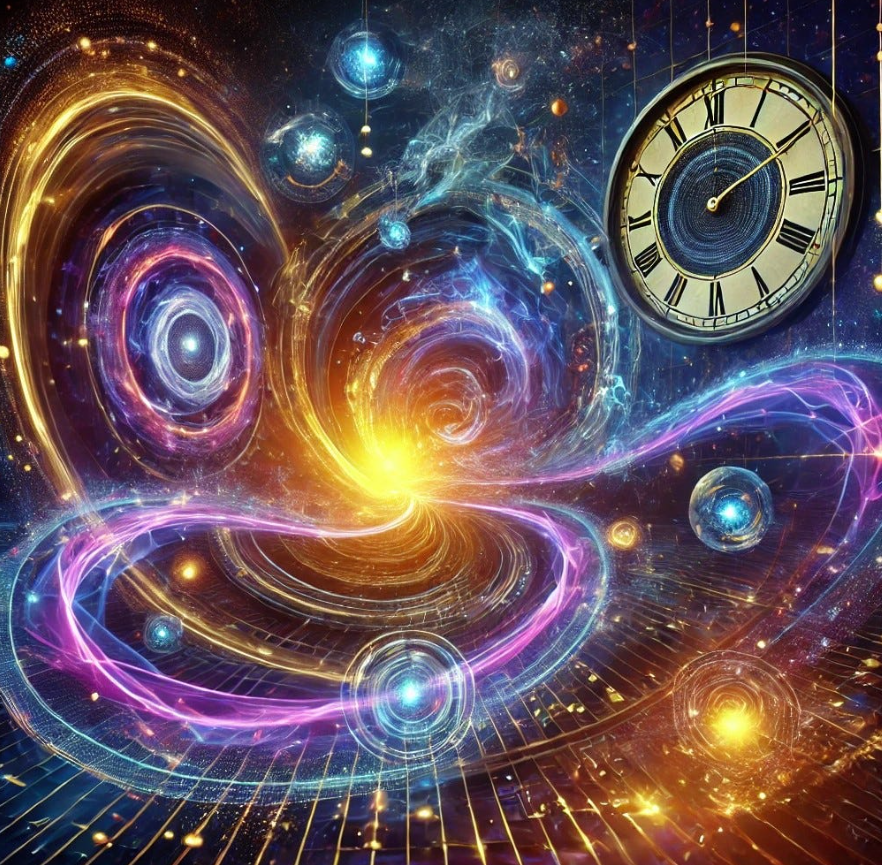
A recent experiment using quantum computers has sparked headlines: scientists claim to have “reversed time” by one second. The idea is dazzling, like rewinding reality itself. But what does this actually mean? And how does it fit within the Fractal Universe framework?
Let’s explore.
What Scientists Actually Did
In this experiment, researchers used a quantum computer to simulate the behavior of a particle over time. Then, using a precise algorithm, they manipulated the quantum state to return it to a previous configuration, effectively “rewinding” the system by one second.
This wasn’t spontaneous time travel. It was a controlled reversal of quantum evolution:
In scientific terms, this is a local reversal of entropy, not a cosmic undoing.
Why Fractal Universe Sees It Differently
From the Fractal Universe perspective, this experiment is not a reversal of time; it’s a nested reconfiguration within a larger Sparksphere that continues unfolding forward.
Here’s why:
In short:
Time doesn’t loop—it layers.
You can simulate reversal, but you cannot escape the recursive memory of action.
Every reversal is a new Action. Every manipulation is a new Fission.
The Sparksphere View of Time
In Fractal Universe, time is not a linear thread; it is a recursive unfolding of Being and Doing:
Even a quantum reversal is a new Spark, a new Fusion, a new Action. It cannot undo the terrain; it can only add to it.
A New Kind of Time Travel
So what does this mean for our understanding of time?
The quantum experiment is remarkable. But it doesn’t break the laws of time; it reveals its structure. And that structure, in Fractal Universe, is not linear. It is nested, remembered, and refracted.
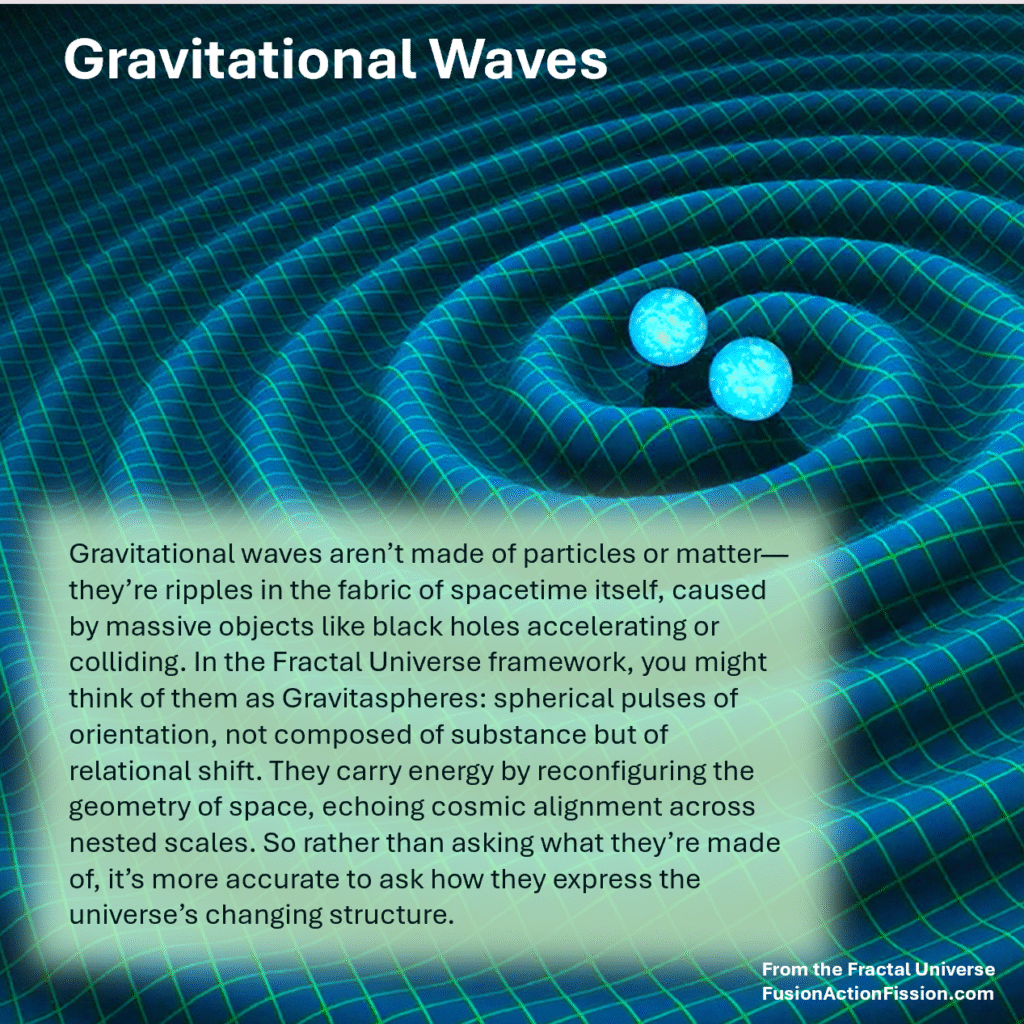
Scientific View: No Center, No Edge
Modern cosmology tells us that the universe has no center. This may seem counterintuitive, but it’s rooted in how scientists understand the Big Bang and the expansion of space:
• The Big Bang wasn’t an explosion in space, it was an expansion of space itself.
• Every point in the universe is moving away from every other point, not from a central origin.
• The universe is homogeneous (the same everywhere) and isotropic (the same in all directions) on large scales.
In this view, the universe is like the surface of an inflating balloon:
• Every point expands away from every other point.
• There is no privileged location: no center, no edge.
This model is supported by large-scale observations, including the cosmic microwave background and galaxy distribution surveys. It’s elegant, mathematically coherent, and deeply humbling.
But it leaves something out.
Fractal Universe: Center Emerges Wherever Awareness Arises
Fractal Universe doesn’t contradict science; it reframes the question. Instead of asking where the center is, it asks how center is experienced.
Every Sparksphere has a center, and at the same time, is the center. From any position, the universe unfolds outward without end. And inward, too, revealing an infinite substrate of memory, possibility, and encoded history.
This is not just poetic, it’s structural.
Wherever awareness finds itself, a Stillpoint emerges. And from that Stillpoint, space arranges itself. Near and far. Inner and outer. Past and future. The center is not a location; it is a dimensionless orientation that anchors perception and gives direction to motion.
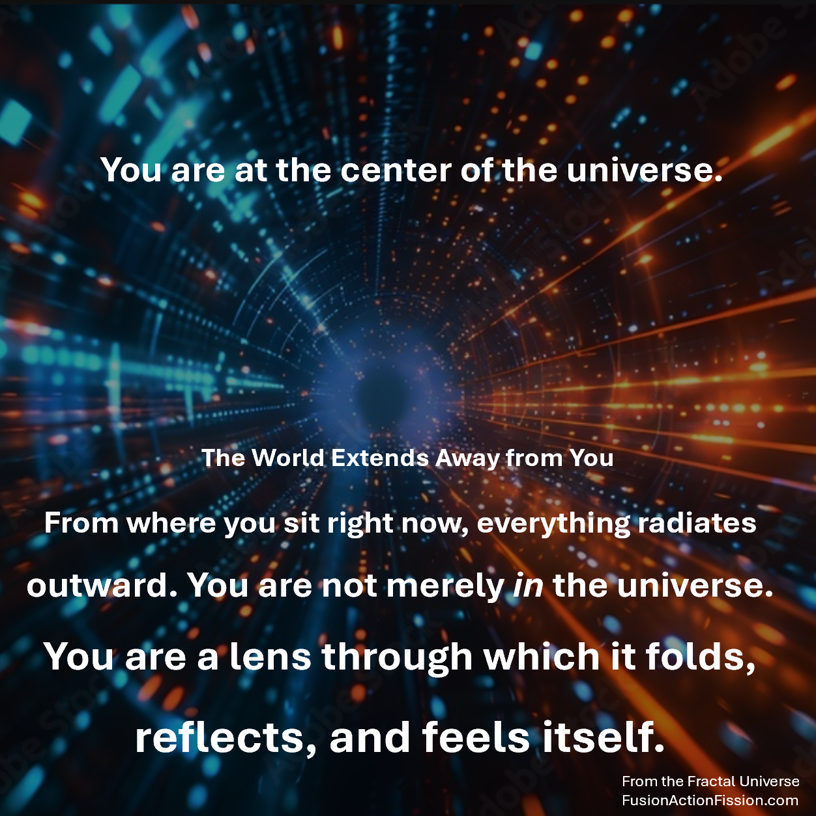
Apply & Observe: The World Extends Away from You
From where you sit right now, everything radiates outward.
The floor beneath you, the sky above, the furniture, the trees, the people.
It all feels “out there” from your center.
This is not just a convenience of perception; it’s a pattern.
You are the local center of the universe’s unfolding fractal.
Pause and notice:
• How does space arrange itself around you? What feels near, and what feels distant?
• Do your thoughts spiral outward, from feeling to concept to action?
• When you stand in your city, does it feel like the center of its region?
• Does your country feel like a world in itself, with everything else orbiting beyond its edge?
• Looking up at a starry night sky, does it seem like space extends away from the Earth?
These nested perspectives—personal, civic, national, planetary—each mirror the same truth:
You are not merely in the universe.
You are a lens through which it folds, reflects, and feels itself.