In Part 1, we looked at a birthday party taking place in the park. We saw the birthday boy at the individual scale, parkgoers at the community scale, the birthday party itself at the cultural scale, and the practice of marking growth and life transitions at the global scale.
Now we are going to zoom in and examine some of the dynamics that occur between scales. A birthday party provides a useful example because we all know what a birthday party is, and what it is not, yet it is not a particularly charged subject.
When we look at Sparksphere dynamics, we find ourselves in a hall of mirrors. Everything is a Sparksphere, and there are Sparkspheres within Sparkspheres, woven together in a dizzying, ever-transforming tapestry. To observe what is happening, we will focus on just three levels:
The Spark: the smaller-scale Sparksphere in our case study. This is the birthday boy. He exists at the individual scale.
The Sparksphere: the mid-scale Sparksphere. This is the Birthday Party Sparksphere. It exists at the cultural scale.
The Atmosphere: the larger-scale Sparksphere. It encompasses all human activity at the global scale. We will call it the Human Atmosphere.
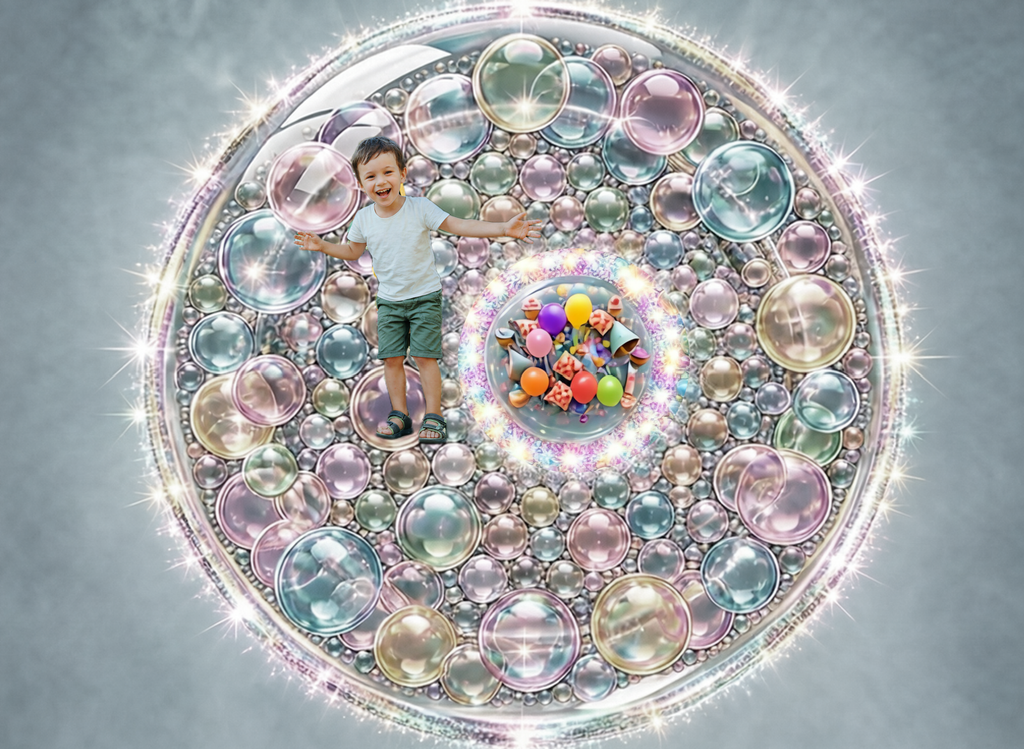
Within the Human Atmosphere exists a Birthday Party Sparksphere. All birthday parties take place within it. If you are planning a birthday party, you draw upon it for ideas. If you are invited to a birthday party, you rely on it for etiquette. If you are celebrating a birthday, you may find yourself inside this Sparksphere, eating cake while friends and family sing “Happy Birthday.”
Along comes our Spark, the birthday boy. His birthday is approaching, so his parents, drawing on the Birthday Party Sparksphere, ask what kind of celebration he would like.
“I want to take a bubble bath and play with my rubber duck,” he replies.
Can this Spark enter the Birthday Party Sparksphere? Does his idea align with what most people recognize as a birthday party?
Not very well.
His suggestion lacks most of the markers that people commonly associate with birthday parties. There are no guests, no games, no cake, and no shared celebration. If we imagine multiple ducks, singing parents, party hats, and birthday candles floating on the edge of the tub, we can begin to see traces of the Birthday Party Sparksphere. As described, however, his idea lives near the fringes of that Sparksphere rather than at its center.
This is important because Sparkspheres are not rigid containers with sharp boundaries. They are more like landscapes of possibility. Some ideas sit comfortably at the center, where nearly everyone recognizes them as belonging. Other ideas exist near the edges, where people disagree about whether they belong at all.
What does it feel like, at the individual scale, to inhabit one of these outer regions of the Birthday Party Sparksphere?
The birthday boy experiences pushback, and it appears to come entirely from other individuals.
His parents tell him that taking a bubble bath is not a party and suggest activities that fit the Birthday Party Sparksphere. His friends may feel disappointed and wonder why he is not having a party where everyone can celebrate together. Some people might even tease or bully him for his unconventional idea.
What should the birthday boy do?
That is up to him.
He can choose a birthday celebration that sits closer to the center of the Birthday Party Sparksphere. Doing so brings social acceptance and perhaps even celebration. Or he can remain committed to his bubble-bath plan and enjoy his birthday exactly as he wishes. The tradeoff is that this choice carries a social cost.
Let’s imagine he chooses the latter.
Although his idea occupies an unusual position within the Birthday Party Sparksphere, it still exists within both the Birthday Party Sparksphere and the Human Atmosphere. The difference is that it sits far from the cultural center of gravity. Most people do not recognize it as a birthday party, so the birthday boy experiences resistance.
Yet the edges of a Sparksphere are often where transformation begins. New possibilities rarely emerge from the center, where expectations are already established. They emerge from individuals exploring combinations that seem strange, impractical, or even unacceptable to others.
Given enough time and some measure of luck, the birthday boy might grow up to become a cultural influencer. Perhaps he becomes a filmmaker and creates a beloved character who spends every birthday taking a bubble bath. The idea spreads. Other people adopt the practice. More stories are told.
In that way, the Spark’s idea might gradually move from the outer edges of the Birthday Party Sparksphere toward its center.
But let us return to the present birthday.
Will it help for the birthday boy to convince his parents and friends that a bubble bath should count as a birthday party?
Probably not.
Although it seems as though these individuals are simply expressing their personal opinions, they are also acting as the visible edge of the Birthday Party Sparksphere. His parents may happily let him take a bubble bath, but they will likely see it as something done instead of a birthday party. His friends may support his choice while still believing he has decided to do something other than have a birthday party. And his critics will not accept the idea that a bubble bath qualifies as a birthday celebration.
Until, perhaps, some future moment when the culture shifts and bubble baths become recognized as a form of birthday party.
If that happens, convincing anyone will no longer be necessary. Everyone will simply know that a bubble bath is one kind of birthday party. It may even become a very popular kind of birthday party for a time.
From a fractal perspective, the birthday boy’s bubble bath is not merely a rejected idea. It is a variation. Most variations disappear, but some persist. A variation that resonates with enough people can gradually move inward, from the margins of a Sparksphere toward its center. What was once considered unusual becomes familiar. What was once a deviation becomes a tradition.
In this way, Sparks are not merely shaped by Sparkspheres. They also participate in their ongoing evolution.
What this example illustrates is the importance of scale within the Fractal Universe.
As individual Sparks, we cannot directly see the cultural Sparkspheres that shape our perceptions. We encounter them indirectly, through the actions and responses of other individuals. We are not inherently bound by the cultural Sparkspheres that exist within the Human Atmosphere, but when we do not align with them there is often a social cost. We experience resistance. We do not fit neatly within prevailing expectations. We may find ourselves less accepted.
Yet Sparkspheres are always changing.
Ideas that once seemed out of place may eventually become commonplace. Likewise, practices that were once central may fade away. In our imagined future where bubble baths are considered birthday parties, it is entirely possible that birthday candles have become unnecessary or even unacceptable.
As we grow older, we witness these shifts again and again. Customs emerge, flourish, transform, and disappear. It can be unsettling to watch taboos become commonplace, and the commonplace become taboo. Yet this continual transformation is part of the process.
No matter how much the details change, the Birthday Party Sparksphere persists. We still turn to it for guidance about how to celebrate, how to behave, and what is considered acceptable.