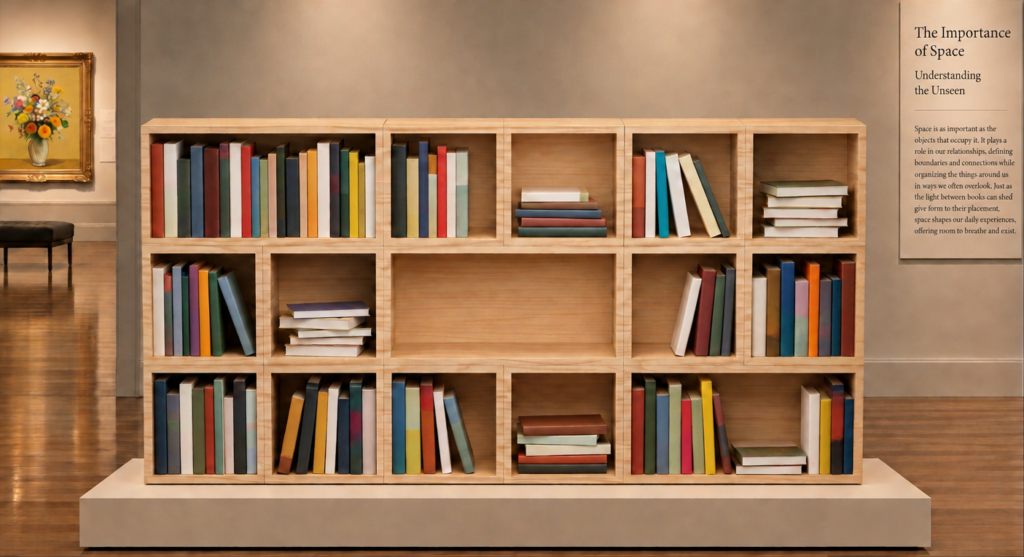
The answer is yes.
We even speak of space as a thing: outer space, the “space” bar on a keyboard, distance from point A to point B, space on a desk, space on a calendar. In everyday life, we recognize countless kinds of space. Space, as I am using the term here, is any place where there is not an object, whether that object is physical like a rock or metaphysical like a thought.
If every Sparksphere has a function, a center, and a perimeter, then space qualifies. Space is a Sparksphere.
Space is necessary for movement. In order for energy to flow, it needs somewhere to go. It’s almost impossible to imagine a world without space, like living inside a diamond where everything is packed together tight. Yet even atoms, which seem solid, are composed mostly of empty space.
When people think of space, they often picture the universe. But the Fractal Universe is not one giant Sparksphere. It does not have a single center or perimeter. Instead, center and perimeter are expressed through countless individual Sparkspheres. Likewise, there is not one universal space-Sparksphere. There are many spaces: space between objects on a desk, space between appointments on a calendar, space between roads on a map, space between galaxies, and space within atoms. Each can be examined as its own Sparksphere.
If space is a Sparksphere, where is its Stillpoint?
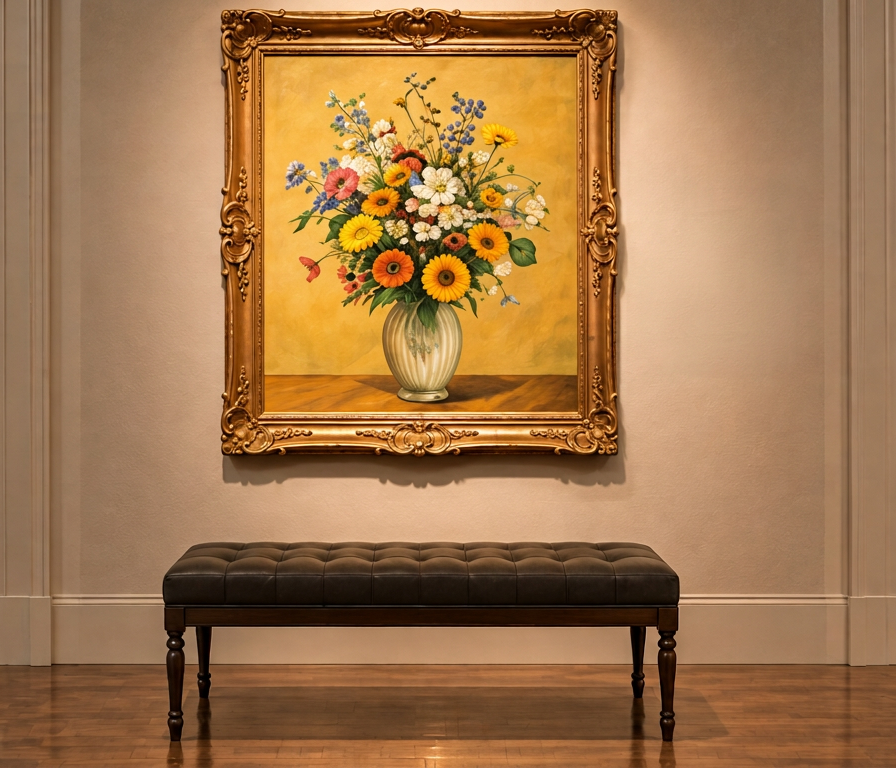
To explore this question, consider a painting of a vase of flowers. The flowers are the object in the painting and surrounding them is empty space. The space is bounded by the edges of the canvas and by the contours of the flowers and vase. This boundary is not a hard line but a Mirror Frontier, a perimeter defined through interaction. The Stillpoint of the space lies at the center of this perimeter. It isn’t necessary to calculate its exact location. Like the Stillpoint of any Sparksphere, it can be felt as a center of balance.
The difference between an object and an empty space is not that one is a Sparksphere and the other is not. Both are. The difference lies in function.
An object has qualities that interact with energy in ways that give it form. Empty space, by contrast, largely allows energy to pass through. We tend to notice the flowers in the painting and overlook the background, yet the background is essential to the image. Without it, the flowers would have nowhere to appear.
Empty space is not the same as nothing. Empty space takes up space; nothing does not. Empty space has a center, a perimeter, and a function. It participates in relationships. It shapes what can happen around it.
What appears to us as a zone of nothingness may be doing something important that we simply fail to perceive. At the very least, it creates room for movement and transformation. It may be doing much more. Scientists have observed phenomena emerging within what appears to be empty space, suggesting that emptiness may not be as empty as it seems. The Fractal Universe extends this idea further. If every Sparksphere contributes pattern to reality, then empty space may be contributing pattern as well.
We experience the characteristics of empty space every day. It feels good to have space in our homes, our workplaces, and our schedules. Spaciousness can feel calming, liberating, or expansive. Different empty spaces affect us differently. The inside of a bowl, the interior of a house, a park, a cathedral, the sky, all are spaces with distinct functions and qualities.
We carefully examine objects while treating space as mere background. We assume we already know what it is because it appears empty. But what if empty space is not simply the absence of something? What if it is a Sparksphere in its own right, quietly helping to organize the world around us?
Apply & Observe:
Spend a few minutes observing a space rather than an object. It might be the space between branches in a tree, the open area in a room, the sky above your neighborhood, or a gap in your daily schedule.
Instead of asking what occupies the space, ask: What is this space doing?
What movements, relationships, possibilities, or transformations depend on it? If this space were a Sparksphere, where might its Stillpoint be? What qualities would you use to describe its character?
If you would like to continue exploring this concept, click here to go to the Journal Portal.